

Running a successful capital campaign often feels like walking a tightrope. On one side, you face the immense pressure to maximize net funds for your organization’s mission. On the other, you carry the responsibility of providing meaningful, lasting recognition that makes your supporters feel truly valued.
Finding the right balance is a serious challenge, especially when looking at the harsh realities of donor retention. Earning a new supporter requires a significant investment of time and resources. If your organization fails to keep first-time givers engaged, your campaign bleeds money. Choosing the right physical recognition method is an excellent way to bridge this gap. By comparing custom engraved bricks to traditional donor plaques, you can develop a strategy that solves these retention challenges and significantly boosts your overall return on investment.
Finding the right balance is a serious challenge, especially when looking at the harsh realities of donor retention. Earning a new supporter requires a significant investment of time and resources. If your organization fails to keep first-time givers engaged, your campaign bleeds money — a dynamic the Fundraising Effectiveness Project, a joint initiative of the Association of Fundraising Professionals and GivingTuesday, tracks closely across the sector. Choosing the right physical recognition method is an excellent way to bridge this gap.
Key Takeaways
- Custom engraved bricks eliminate upfront inventory expenses, offering much higher profit margins than installing traditional plaque walls.
- Scalable, tangible recognition methods are necessary for capturing grassroots contributions, which represent the vast majority of nonprofit funding.
- Entry-level physical recognition builds an emotional connection, helping organizations retain first-time givers until they mature into major donors.
- Combining outdoor brick walkways with high-tier indoor plaques creates a profitable, multi-tiered giving strategy that maximizes overall capital.
The Financial Risk: Upfront Costs and Profit Margins
Traditional donor plaques and massive recognition walls are beautiful, but they often carry a heavy financial burden. Organizations usually have to commission these installations well before they secure the donations to pay for them. Buying brass, bronze, or large glass fixtures requires a significant upfront capital investment. This early expenditure eats directly into your campaign’s net profit before you even launch.
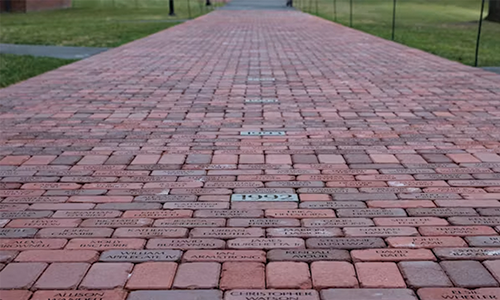
By contrast, a brick fundraising campaign operates on a highly profitable pre-sale model. You map out a designated area, such as a garden walkway or a new plaza, and sell the spaces to your community. You only purchase the materials after the donor has already paid for them.
When planning a capital campaign, balancing the cost of donor recognition with the need to maximize profits is a common hurdle. Opting for custom engraved bricks allows organizations to scale their giving tiers effortlessly, offering a permanent, tangible honorific that requires zero upfront inventory costs. Your organization holds onto the capital, minimizing financial risk and keeping your budget securely in the black.
You can also turn this model into a lucrative secondary revenue stream. Many donors want to display their contribution at home or in their office. By offering exact, full-scale replica packages shipped directly to your supporters with a Certificate of Authenticity, you create an effortless upsell. This adds immediate extra revenue to your campaign with very little extra work for your team.
Scalability: Honoring Everyday Supporters and Major Sponsors
Donor plaques are fantastic for recognizing a handful of major corporate sponsors or wealthy benefactors. A bronze plaque outside a newly funded wing commands respect and attention. However, this method completely lacks the scalability needed to honor hundreds of grassroots supporters. If you try to give every mid-level giver a wall plaque, your facility will quickly look cluttered and run out of space.
Building an accessible recognition tier for everyday supporters is essential for long-term fundraising success. A campaign that only caters to high-net-worth individuals leaves massive amounts of potential funding on the table.
A brick walkway or plaza display solves this spatial challenge by scaling horizontally. It effortlessly accommodates both a $100 community donor and a $1,000 mid-level sponsor in the same unified installation.
A family can purchase a standard 4″ x 8″ text brick to memorialize a loved one, while a local business can sponsor an 8″ x 8″ brick featuring their custom corporate logo. Both parties receive permanent recognition in a shared community space. This inclusive approach makes everyone feel like an integral part of your mission, driving up total donation volume.
Long-Term ROI and Donor Retention Strategy
Fundraising is about building relationships, not just collecting checks. Providing a physical, lasting tribute creates a powerful emotional tie between your organization and your community. When a family can physically visit a site and point to their name, they remain deeply invested in your ongoing mission.
Playing the long game with donor stewardship is a necessity. You need a way to keep those early-stage supporters engaged during that multi-year gap. A custom engraved brick acts as the perfect stepping-stone honorific. It provides the immediate, tangible engagement required to retain a first-time giver. When you honor a new supporter early in their journey, you build the trust and loyalty needed to eventually cultivate them into a plaque-level contributor down the road.
To keep that connection strong, organizations can also use miniature replica bricks. These small, exact copies of the installed brick make excellent desktop keepsakes or promotional giveaways. Sitting on a donor’s desk, a miniature replica keeps your organization top-of-mind year-round, serving as a constant visual reminder of their philanthropic impact.
Durability and Maintenance: Outdoor vs. Indoor Installations
When planning physical recognition, you must account for long-term maintenance. An honorific that falls apart after five years will only frustrate your donors and damage your organization’s reputation.
| Feature / Aspect | Custom Engraved Bricks | Donor Plaques |
|---|---|---|
| Ideal Location | Outdoor (Walkways, Plazas, Gardens) | Indoor (Lobbies, Hallways, Offices) |
| Expected Lifespan | Lifetime (Highly weather-resistant) | Varies (Indoor: Long; Outdoor: Prone to wear) |
| Maintenance Costs | Near Zero (Self-cleaning with rain/sweeping) | Moderate to High (Requires polishing, weatherproofing) |
Traditional outdoor recognition methods come with significant drawbacks. Techniques like sandblasting or painting often fail when exposed to the elements. The paint fades in the sun, and the epoxy fills chip and peel after cycles of freezing and thawing. Fixing these issues requires costly upkeep, draining funds from your maintenance budget.
The solution is utilizing patented laser brick engraving technology. Instead of carving away the surface and filling it with paint, high-powered lasers vitrify the design directly into the brick. The heat transforms the clay into a dark, glass-like mark that is actually harder than the brick itself.
This advanced method results in sharp, intricate details that can perfectly replicate complex corporate logos or actual handwritten signatures. Because there is no paint to peel or epoxy to chip, these installations withstand harsh weather conditions and require practically no maintenance over their lifetime.
Structuring Your Capital Campaign with Tiered Giving
To raise the most capital possible, the smartest strategy is not choosing between bricks and plaques, but combining them. A hybrid approach allows you to capture every level of giving.
You can utilize elegant glass or metal plaques for major indoor spaces, such as offering naming rights for a new room or building. Simultaneously, you can launch a custom brick walkway leading up to that very building, creating a community-driven outdoor space for your grassroots supporters.
Launching this tiered strategy requires a few straightforward logistical steps:
- Establish Contribution Thresholds: Clearly define your giving levels. For example, you might set a $150 entry point for a standard 4″ x 8″ text brick, $500 for an 8″ x 8″ logo brick, and $10,000 or more for an exclusive indoor plaque.
- Secure Leadership Buy-In: Before going public, present the concept to your board of directors. Requesting free brick samples from your engraving partner is a great way to let the board feel the quality and permanence of the product.
- Launch the Pre-Sale: Announce the campaign to your community, using mock-ups of the future walkway to generate excitement.
Managing hundreds of individual brick orders might sound overwhelming, but turnkey brick fundraising solutions make it entirely manageable. These comprehensive services guide an organization from the initial campaign creation to the final installation. They provide order forms, donor management tools, and design assistance, ensuring maximum donation volume and seamless execution for your team.
Conclusion
To raise the most capital and ensure long-term retention, nonprofits must select a recognition method that balances low upfront costs with high donor engagement. While donor plaques hold an important place for recognizing massive contributions, they simply cannot scale to accommodate the broader community.
Custom engraved bricks offer a strategic advantage. They provide highly scalable giving tiers, boast superior durability through laser vitrification technology, and allow you to turn donor recognition into a high-margin revenue stream. Because they operate on a zero-inventory model, your organization protects its budget while still offering a permanent, emotional tribute.
Successful fundraising is never just about hitting a financial target. It is about honoring the people who make your work possible while sustainably funding your mission. By implementing a tiered recognition strategy, you give every supporter a permanent place in your organization’s history.