

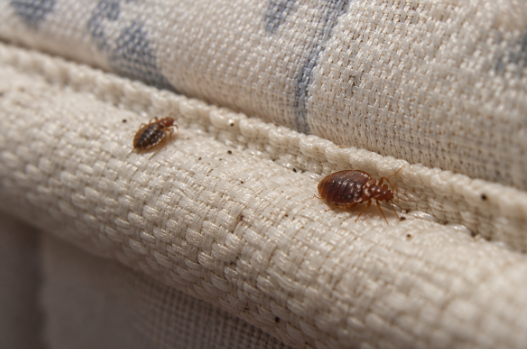
Bed bugs are among the most difficult household pests to control. They are small, highly adaptable insects that hide in narrow cracks and crevices, usually close to where people sleep or rest. They are mainly active at night and can survive for long periods without feeding, making an established infestation particularly difficult to eliminate.
For anyone trying to get rid of bed bugs, simply cleaning the room or applying an insecticide to a few visible surfaces is rarely enough. Bed bugs can remain hidden inside bed frames, furniture joints, wall cracks and other areas that are difficult to reach directly.
This is where fumigants can sometimes become part of a more comprehensive pest control strategy. However, their effectiveness depends heavily on the product being used, correct application and how well the treatment is integrated with other control methods.
What are bed bug fumigants and how do they work?
Fumigants are pest control products designed to release an insecticidal substance that disperses through an enclosed space. Unlike conventional liquid insecticides, which are primarily applied to specific surfaces, fumigant products can distribute their active ingredient throughout the treated volume.
This can make them useful for reaching areas that are difficult to access directly, including cracks, gaps, furniture cavities and other sheltered locations.
Depending on the product formulation, the active ingredient can affect exposed insects through contact or other modes of action. Some products can produce a relatively rapid knockdown of insects that are exposed during treatment.
However, the fact that a fumigant disperses through a room does not mean that every hidden bed bug will automatically be eliminated. Bed bugs can remain deep inside cracks, crevices and other protected areas, and the effectiveness of treatment depends on the product, application conditions and the level of exposure.
For this reason, fumigation should generally be considered as one component of an integrated bed bug control programme rather than a standalone answer.
The “flush-out” effect
One of the useful effects associated with certain insecticidal aerosols or fumigant-type treatments is a flushing or knockdown effect.
The insecticide can disturb active insects and encourage them to leave some of their hiding places. Once exposed, they have a greater chance of coming into contact with the insecticide.
This can be particularly useful when treating pests that spend most of their time hidden. Bed bugs commonly shelter in mattress seams, bed frame joints, cracks, furniture and other protected areas, so encouraging movement can increase exposure to treated surfaces.
However, the flush-out effect should not be confused with complete elimination. Bed bugs can remain protected in areas that the treatment does not adequately penetrate, particularly when harbourages are deep or inaccessible.
This is why relying exclusively on a fumigant can leave part of the infestation untreated.
When can fumigants be used for bed bugs?
Fumigant or aerosol-based treatments may be considered when an infestation is extensive or when insects are present in areas that are difficult to treat with conventional spraying.
They can be particularly useful as a complementary treatment in:
- Bedrooms with extensive bed bug activity
- Upholstered furniture
- Guest rooms and accommodation facilities
- Vacant apartments
- Areas with numerous cracks and concealed spaces
- Rooms where access to certain harbourages is limited
The exact suitability depends on the specific product and its label. Not every fumigant is approved for every type of premises or pest, so the product instructions should always determine where and how it can be used.
Combining fumigation with other treatments
One of the most important aspects of bed bug control is using different methods for different parts of the infestation.
A residual spray can be applied to suitable surfaces such as bed frames, cracks, furniture joints, skirting boards and other areas where bed bugs are likely to travel.
A fumigant or aerosol treatment can then complement this application by distributing insecticide through the treated space and reaching areas that are more difficult to access directly.
The two approaches therefore have different roles:
- Targeted spraying treats suitable surfaces and can provide residual activity.
- Fumigant or aerosol treatment helps expose insects in difficult-to-reach areas.
- Vacuuming can physically remove insects, shed skins and other debris.
- Monitoring helps determine whether bed bug activity is continuing.
- Follow-up treatments address insects that emerge after the initial intervention.
This combination is generally more useful than relying on a single application method.
It is also important to check product compatibility. Some insecticides should not be used in combination with certain baits or other treatments, and some require specific ventilation or re-entry procedures.
How to use fumigants correctly
The effectiveness of a fumigant depends not only on the product but also on preparation and application. The instructions on the product label should always take priority.
Choose the correct dose
The amount of product required depends on the volume of the treated space and the specific product formulation. Using too little may result in inadequate exposure, while using more than the recommended amount does not necessarily improve the treatment and can increase risks.
Before treatment, calculate the volume of the room and determine the required dose according to the product instructions. In multi-room properties, each room may need to be assessed separately rather than assuming that one unit will treat the entire property.
Place the product correctly
Placement can influence how the product disperses throughout the room.
For bed bug treatments, the main areas of concern are usually around beds, sofas and other resting areas where the insects are likely to harbour. However, the product should only be placed in locations permitted by its label.
Furniture should be positioned so that the treatment can reach the intended areas, while unnecessary obstacles should be removed where possible.
The goal is to allow the insecticide to distribute as intended without creating additional exposure risks.
Treat multiple rooms carefully
Bed bugs can move between rooms, particularly in larger properties or apartment buildings. However, a fumigant released in one room should not be expected to provide reliable treatment throughout an entire home.
Each space should be assessed individually. If several rooms require treatment, they should be prepared and treated according to the product instructions.
The treatment sequence should also be planned so that unnecessary exposure is avoided during application and the property can be safely vacated before treatment begins.
Exposure time and ventilation
The required exposure period varies considerably depending on the product. Some treatments require the room to remain closed for a specified period, followed by a defined ventilation period.
There is no universal rule that every fumigant should be left for exactly the same amount of time. The manufacturer’s instructions must be followed.
Once the required exposure period has passed, the premises should be ventilated according to the product label before anyone re-enters.
Ventilation is particularly important because it helps reduce airborne residues before the room is occupied again. Children, pets and other occupants should remain outside the treated area for the entire period specified by the product instructions.
Common mistakes when using bed bug fumigants
Although fumigant products may appear straightforward to use, several mistakes can reduce their effectiveness or create unnecessary risks.
Using one unit for several rooms: A single product may not provide sufficient exposure throughout a multi-room property. Each space needs to be considered separately according to the product’s coverage requirements.
Placing the product incorrectly: The location of the treatment unit can influence how the active ingredient disperses. Always follow the placement instructions provided by the manufacturer.
Skipping the complementary treatment: Fumigation should not automatically replace targeted treatment of areas where bed bugs are likely to hide. Hidden insects can remain protected in cracks, furniture joints or other hard-to-reach locations.
Re-entering too soon: Entering the treated area before the required exposure and ventilation periods have passed can create unnecessary exposure. The specified re-entry instructions should always be respected.
Ignoring preparation: Clutter, unnecessary objects and inaccessible furniture can create additional harbourages and interfere with treatment. Preparing the room properly can make inspection and treatment more effective.
The real role of fumigants in bed bug control
Fumigants should not be viewed as a magic solution that eliminates an established bed bug infestation with one application. Their main value is as a complementary tool that can extend the reach of a treatment programme.
This is particularly relevant for bed bugs because they spend much of their time hidden in cracks, joints, furniture and other protected locations. A combination of targeted residual treatment, appropriate aerosol or fumigant application, monitoring and follow-up can address different parts of the infestation.
The exact strategy depends on the size of the infestation, the type of property and the products being used.
From the first treatment to long-term bed bug control
If the goal is to get rid of bed bugs, the treatment needs to address more than the insects that are visible at the time of application.
Fumigants can help extend insecticide coverage through an enclosed space, while targeted spraying can provide residual treatment on suitable surfaces. Vacuuming, inspection and follow-up applications can then help deal with insects or eggs that remain after the first intervention.
The most important point is that bed bug control is usually a process rather than a single event. Correct preparation, appropriate dosing, careful application, sufficient exposure time and proper ventilation all contribute to a safer and more effective treatment.
When fumigants are used as part of a broader pest control strategy, rather than as a standalone solution, they can be a useful tool for tackling bed bugs in areas that are otherwise difficult to reach.