

The Foundation of Home Energy Efficiency and Comfort: Building Envelope and Air Sealing
Your home’s building envelope—the physical barrier between the conditioned interior and the outside world—is the most critical factor in determining how much energy you use. If your home is leaking air, even the most expensive heating and cooling system will struggle to maintain a comfortable temperature.
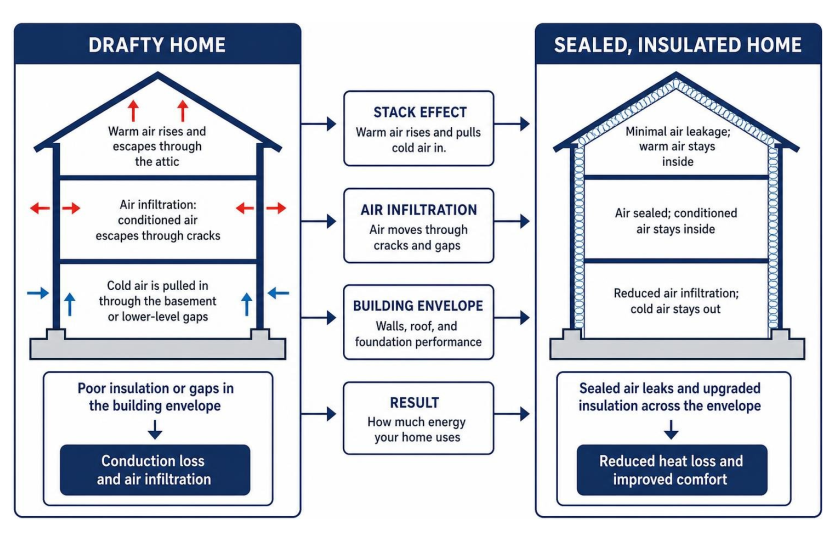
Thermal performance is dictated by how well your walls, roof, and foundation resist heat flow. When a home has poor insulation or gaps in the building envelope, it suffers from conduction loss, where heat moves directly through materials, and air infiltration, where conditioned air escapes through cracks. In many homes, the “stack effect” drives this process; warm air rises and escapes through the attic, pulling cold air in through the basement or lower-level gaps. To identify these hidden energy thieves, a blower door diagnostic test is an invaluable tool. This test depressurizes the home, making it easy to spot exactly where air is leaking throughout the structural perimeter.
Sealing Air Leaks and Upgrading Insulation for Draft-Free Living
Drafts are more than just a nuisance; they are a clear sign that your thermal boundary is compromised. The most effective way to address this is by sealing thermal bypasses—areas where air can move behind walls, around recessed lighting fixtures, or through open floor cavities—and upgrading your insulation. While traditional fiberglass batts have been the industry standard for decades, modern solutions offer superior performance. Utilizing high-performance spray foam insulation allows for a seamless, airtight seal that fills irregular gaps and provides a consistent thermal barrier. By optimizing your R-value (a measure of insulation’s resistance to heat flow), you create a stable, comfortable environment that keeps indoor temperatures consistent regardless of the weather outside. Addressing common problem areas like band joists, attic kneewalls, and cantilevered floors stops unconditioned air right at the structural perimeter.
Before adding insulation, it is important to seal penetrations for plumbing, wiring, chimneys, and exhaust fans so that the insulation can perform as intended. Insulation slows heat transfer, but it does not always stop air movement on its own. A thoughtful approach also includes maintaining proper attic ventilation where required, installing baffles to protect soffit airflow, and using fire-safe materials around heat-producing fixtures. In basements and crawl spaces, controlling moisture with drainage, vapor management, and sealed rim joists helps prevent damp insulation and hidden mold. These details may seem small, but together they determine whether an upgrade delivers measurable comfort and energy savings.
Addressing Thermal Loss in Windows, Doors, and Ductwork
Windows and doors are often the weakest links in your home’s envelope. Modern windows with low-emissivity (Low-E) glass coatings are designed to reflect infrared light, keeping heat inside during the winter and outside during the summer. When selecting these upgrades, look for NFRC energy ratings that specify the U-factor (the rate of heat loss) and the Solar Heat Gain Coefficient (how much solar heat the window lets in). Double- or triple-pane units equipped with warm-edge spacers and inert gas fills provide enhanced thermal resistance against seasonal extremes.
Furthermore, do not overlook your ductwork. In many homes, ducts run through unconditioned spaces like attics or crawl spaces. If these ducts are not properly sealed with mastic or foil tape, you could be losing a significant portion of your heated or cooled air before it ever reaches your living rooms. In addition to sealing seam gaps, insulating unconditioned duct runs prevents condensation and thermal transfer, ensuring that warm or cool air arrives at your registers at the intended temperature.
Modern Heating and Cooling: The Shift to High-Efficiency Heat Pumps
Space conditioning accounts for more than half of the average home’s energy consumption. As technology evolves, the industry is shifting away from fossil-fuel-burning furnaces toward high-efficiency air-source heat pumps. Unlike traditional systems that generate heat by burning fuel, heat pumps move existing heat from one place to another.
Upgrading to Heat Pumps for Year-Round Home Energy Efficiency and Comfort
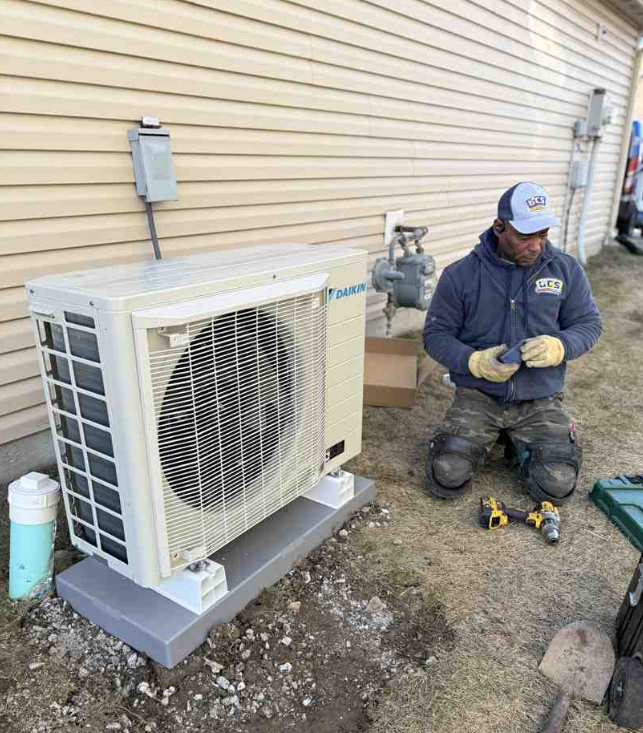
Heat pumps provide a versatile, year-round solution by offering both heating and cooling in a single, integrated system. Modern variable-speed inverter compressors allow these units to run at lower, more efficient levels for longer periods, rather than constantly cycling on and off. This results in fewer temperature fluctuations and a much quieter operation. For those in colder climates, modern cold-climate heat pumps are engineered to maintain high efficiency even when outdoor temperatures drop well below freezing.
Maximizing Efficiency with Heat Pump Water Heaters
Water heating is typically the second-largest energy expense in a home. Traditional electric water heaters are notoriously inefficient, but heat pump water heaters (HPWH) function like a refrigerator in reverse. They extract heat from the ambient air in your home and transfer it into the water tank. Because they move heat rather than generating it through electric resistance, they can achieve a coefficient of performance that drastically reduces the energy required to provide hot water for your family.
Balancing Indoor Air Quality and Ventilation in Airtight Homes
As we tighten our homes to save energy, we must be intentional about air exchange. An airtight home is an energy-efficient home, but it requires a dedicated strategy to ensure the air inside remains fresh and healthy. Without proper ventilation, moisture, odors, and pollutants can become trapped.
Managing Humidity, Radon, and Airborne Contaminants
Indoor air quality (IAQ) is influenced by everything from cooking and cleaning products to natural soil gases. Radon, a naturally occurring radioactive gas, can seep into homes through foundation cracks; in an airtight home, it is essential to have proper radon mitigation systems in place. Additionally, managing relative humidity is vital to prevent mold growth, which thrives in damp, stagnant air. A pre-retrofit diagnostic assessment can help you identify these risks before you finalize your energy upgrades.
Implementing Mechanical Ventilation: HRVs and ERVs
The solution to maintaining IAQ in an airtight home is balanced mechanical ventilation. Heat Recovery Ventilators (HRVs) and Energy Recovery Ventilators (ERVs) are designed to exhaust stale indoor air while bringing in an equal amount of fresh outdoor air. As these air streams pass each other, the system transfers heat (and in the case of ERVs, moisture) from the outgoing air to the incoming air. This allows you to enjoy constant fresh air circulation without losing the energy you spent to heat or cool your home.
Smart Controls, Maintenance, and Low-Cost Upgrades
Efficiency is not just about the equipment you buy; it is about how you manage it. Smart technology and consistent maintenance ensure that your systems continue to perform at their peak for years to come.
Achieving Home Energy Efficiency and Comfort Through Smart Thermostats
A smart thermostat is one of the most accessible upgrades for any home. By using occupancy detection and learning algorithms, these devices can automatically adjust the temperature when you are away or asleep. They can also manage peak load times, helping you reduce energy usage when demand on the grid is highest. Remote climate control ensures that you can always return to a home that is perfectly conditioned to your preference.
System Maintenance and Low-Cost Retrofits for Renters and Multifamily Units
If you are a renter or living in a multifamily unit, you may not be able to install a new heat pump, but you can still make significant improvements. Regular air filter replacements and keeping evaporator coils clean are essential tasks that prevent your HVAC system from overworking. We highly recommend scheduling seasonal tune-ups with a professional HVAC service provider to catch minor issues before they become expensive repairs.
Cost-Effective Renter Energy Upgrades:
- Window Inserts:Use clear plastic film or insulated window covers to reduce drafts.
- LED Lighting:Replace all incandescent bulbs to reduce heat and electricity usage.
- Power Strips:Use smart power strips to eliminate “phantom” energy loads from electronics in standby mode.
- Door Sweeps:Install simple adhesive door sweeps to stop air leaks at the bottom of exterior doors.
Strategic Renovation Planning and Financial Incentives
When planning a renovation, think of your home as a single, interconnected system. A whole-house energy assessment should always be your first step. By sequencing your projects—starting with the building envelope (insulation and air sealing) before upgrading your HVAC equipment—you can often downsize the capacity of the new equipment you purchase. Heating and cooling contractors perform precise heating and cooling load calculations (often called Manual J calculations), and an airtight, well-insulated structure requires significantly fewer BTUs to heat and cool. This saves you substantial upfront capital on equipment sizing as well as ongoing utility costs over the lifespan of the system.
Furthermore, financial incentives are more robust than ever. The Inflation Reduction Act offers the 25C Energy Efficient Home Improvement Credit, which provides significant tax relief for qualifying upgrades like heat pumps, insulation, and high-efficiency windows. Many local utilities also offer rebate programs that can further offset your upfront costs. Combining federal tax credits, state clean energy grants, and utility-level cash-back incentives can significantly lower the net cost of comprehensive home performance retrofits, providing an immediate return on your investment while permanently cutting household utility bills.
Frequently Asked Questions About Home Energy Efficiency and Comfort
What are the most cost-effective first steps for improving home energy efficiency?
The best starting point is a professional energy assessment. Following that, prioritize air sealing and adding insulation to your attic. These measures offer the highest return on investment by addressing the primary sources of energy loss. Installing a smart thermostat and sealing your ductwork are also highly effective, low-cost steps.
How does an airtight building envelope affect indoor air quality?
While an airtight envelope prevents energy loss, it also restricts natural air infiltration. This makes it necessary to install mechanical ventilation, such as an HRV or ERV, to ensure a constant supply of fresh, filtered air while flushing out indoor pollutants and excess moisture.
What financial incentives and tax credits offset energy efficiency upgrades?
Homeowners can benefit from the federal 25C Energy Efficient Home Improvement Credit, which covers a percentage of the cost for qualifying heat pumps, water heaters, and insulation. Additionally, many states and local utility providers offer direct rebates for energy-efficient equipment. We recommend checking with your local utility provider to see what programs are currently active in your area.
Conclusion
Maximizing your home’s comfort is a journey that combines building science with smart technology. By focusing on the “foundation first” approach—sealing leaks and improving insulation—you create a durable, high-performance home that requires less energy to maintain. When you pair this robust envelope with modern, efficient systems like heat pumps and proper mechanical ventilation, you achieve a level of comfort and air quality that is simply not possible in a drafty, inefficient house. Whether you are planning a deep energy retrofit or simply looking for ways to lower your monthly bills, these improvements are a sound investment in your home’s future and your family’s well-being.