

The Evolution of Modern Commercial Construction and Engineering
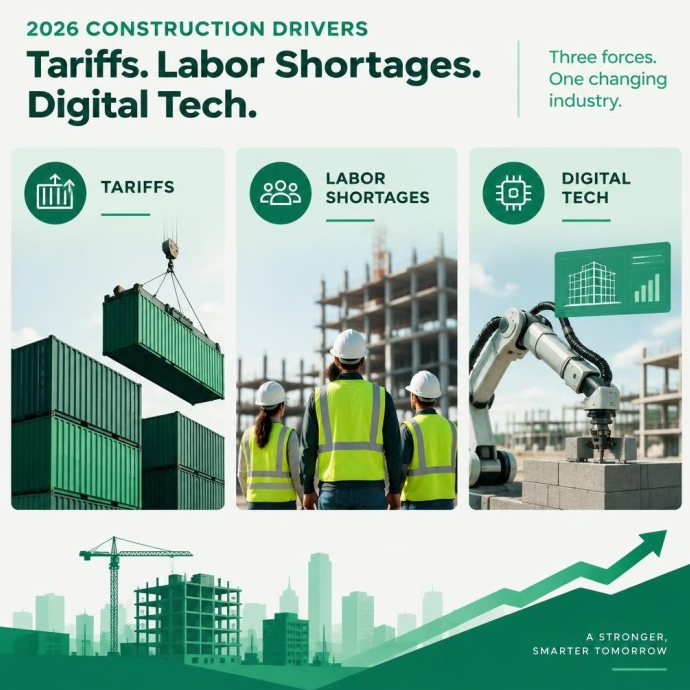
The year 2026 marks a transition point for the commercial construction and engineering sector. After a period of cooling, the industry is recalibrating to meet the demands of a changing economic landscape. We are observing a pivot from the decline seen in 2025 toward a projected 1.8% growth in structural investment. However, this growth is not without friction. With effective tariff rates on construction goods reaching a 40-year high of 25% to 30%, firms are facing unprecedented pressure on procurement budgets.
Supply chain volatility has forced a shift in strategy. Where contractors once relied on “just-in-time” delivery, we are now seeing a move toward strategic stockpiling and a preference for domestic sourcing to mitigate the risks of global tariff fluctuations. Simultaneously, the industry faces a significant human capital challenge. With nearly 41% of the workforce expected to retire by 2031, the competition for talent is intense. As of August 2025, construction wages have risen by 4.2% year-over-year, reflecting the scarcity of skilled labor.
Mitigating Labor Deficits Through Innovation
To bridge the gap between the 499,000 new workers required in 2026 and the available talent pool, firms are increasingly turning to technology. Automation is no longer a futuristic concept; it is an immediate necessity. By integrating robotics for repetitive tasks—such as bricklaying or site surveying—companies can maintain output levels even with a smaller crew. Furthermore, prefabrication and modular construction are gaining traction, moving labor-intensive processes into controlled factory environments where efficiency can be tightly managed.
Navigating Tariffs and Material Cost Pressures
Resilience in the face of rising costs requires a proactive stance on contract management. We are seeing a widespread adoption of tariff-adjustment clauses, which allow contractors to share the risk of material price spikes with project owners. Beyond contractual safeguards, data-driven supply chain visibility platforms are becoming essential. By utilizing predictive analytics, firms can identify potential material shortages before they derail a project timeline, allowing for timely material substitution or early procurement.
Advanced Project Delivery and Value Engineering Frameworks
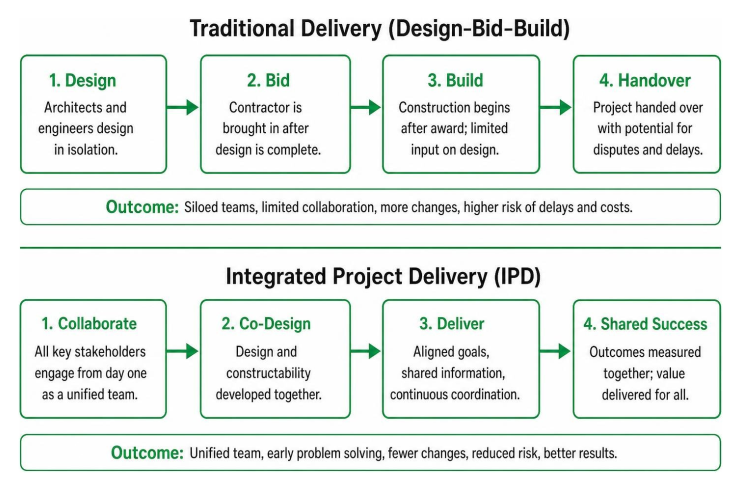
The choice of project delivery method is often the single most significant factor in a project’s success. While traditional design-bid-build remains common, it often creates silos that inhibit communication. In contrast, Design-Build and Integrated Project Delivery (IPD) models foster a collaborative environment where architects, engineers, and contractors work as a unified team from day one.
Implementing Value Engineering in Commercial Construction and Engineering
Value Engineering (VE) is frequently misunderstood as mere cost-cutting. In reality, it is a structured, five-phase process: Information Gathering, Functional Analysis, Creative Brainstorming, Evaluation, and Implementation. Rooted in manufacturing methodologies developed during World War II, VE is most effective when applied during the preconstruction phase. By analyzing the function of every component—such as evaluating whether a specific structural steel grade is necessary for the load requirements—teams can optimize costs without sacrificing quality or safety.
Integrated Project Delivery and EPC Models
For complex infrastructure, the Engineering, Procurement, and Construction (EPC) model provides a single point of responsibility that drastically reduces coordination errors. When teams utilize integrated engineering and construction, they eliminate the friction often found at the handoff between design and execution, ensuring that constructability is built into the design from the start.
Structural Systems, Site Preparation, and Material Selection
Medium and high-rise commercial projects require a meticulous approach to structural integrity. The selection of materials, from high-strength concrete shafts to composite floor systems, must be balanced against site-specific constraints and the availability of specialized equipment.
Substructure Execution and Foundation Engineering
Before the first column is erected, the ground beneath must be prepared with precision. Deep basement excavation and soil stabilization are high-risk activities that demand expert oversight. Engaging in full-service demolition and excavation allows for a seamless transition from site clearing to foundation work, ensuring that geotechnical risks are managed by a single, accountable entity.
Superstructure Materials and Fire Safety Considerations
Material selection is dictated by both performance and regulatory compliance. As building codes become more stringent regarding fire safety, the use of advanced materials, including fire-retardant-treated wood, has become more common in specific commercial applications to meet safety standards while maintaining architectural flexibility.
Digital Transformation and Organizational Dynamics
The industry is undergoing a profound digital shift, driven by Building Information Modeling (BIM). While 3D modeling provides spatial clarity, the real power lies in 4D (time) and 5D (cost) integration. By linking the construction schedule and budget to the 3D model, project managers can visualize the project’s evolution and detect potential clashes before they manifest on-site.
Technological Integration in Commercial Construction and Engineering
AI-driven scheduling and autonomous drones for site mapping have transformed how we monitor progress. These tools provide real-time data that allows for dynamic decision-making. However, technology is only one part of the equation. Our research indicates that BIM-enabled projects often suffer from “organizational coupling” issues, where the technical transparency of the model exposes, rather than solves, existing organizational silos.
Resolving Organizational Silos in BIM-Enabled Projects
The MEP (Mechanical, Electrical, and Plumbing) coordinator has emerged as a de-facto leader in many BIM-enabled projects. Because MEP systems are the most complex to integrate, the coordinator often acts as a bridge between trades. To succeed, firms must establish clear communication protocols that supersede individual company objectives, ensuring that the shared digital model serves as a tool for collaboration rather than a source of contention.
High-Growth Sectors: Data Centers and Energy Infrastructure
The explosion of AI and enterprise computing has placed an unprecedented demand on the commercial construction sector. Deloitte estimates that power demand from U.S. data centers could grow more than fivefold by 2035, reaching 176 gigawatts. This is not just a technology trend; it is a massive construction opportunity.
Power Demands and Mission-Critical Facilities
Data center construction requires specialized expertise in high-density cooling, uninterrupted power supply (UPS) systems, and modular infrastructure. These projects operate on compressed timelines where every day of delay represents a significant loss of operational revenue for the client.
Resilient Utility and Renewable Power Integration
Beyond data centers, the modernization of the electrical grid is a major growth area. From constructing battery energy storage systems (BESS) to upgrading substations, commercial contractors are increasingly acting as energy infrastructure partners. This requires a deep understanding of utility-grade electrical systems and a commitment to maintaining the resilience of the energy grid.
Frequently Asked Questions About Commercial Construction
How does early value engineering impact total project lifecycle costs?
Early-stage value engineering shifts the focus from initial capital expenditure to total lifecycle performance. By involving contractors during the design phase, teams can select materials and systems that are not only cheaper to install but also more efficient to maintain and operate over the building’s lifespan.
What are the main differences between 3D, 4D, and 5D BIM applications?
3D BIM focuses on spatial geometry and clash detection. 4D BIM adds the dimension of time, linking the construction schedule to the model for phased sequencing. 5D BIM incorporates cost data, allowing for real-time financial tracking and budget control as the design evolves.
How are commercial contractors mitigating the 2026 skilled labor shortage?
Contractors are adopting a three-pronged approach: investing in digital workflows to increase the productivity of existing staff, utilizing prefabrication to move work off-site, and partnering with vocational institutions to create a sustainable pipeline of new talent.
Conclusion
The future of commercial construction and engineering lies in the convergence of digital capability and organizational synergy. While economic pressures and labor shortages present significant hurdles, they also serve as catalysts for innovation. By embracing integrated project delivery, leveraging advanced BIM workflows, and fostering a culture of cross-disciplinary collaboration, firms can not only navigate the challenges of 2026 but thrive in them. The projects of the future will be defined by their resilience, their efficiency, and the seamless integration of the teams that build them.