

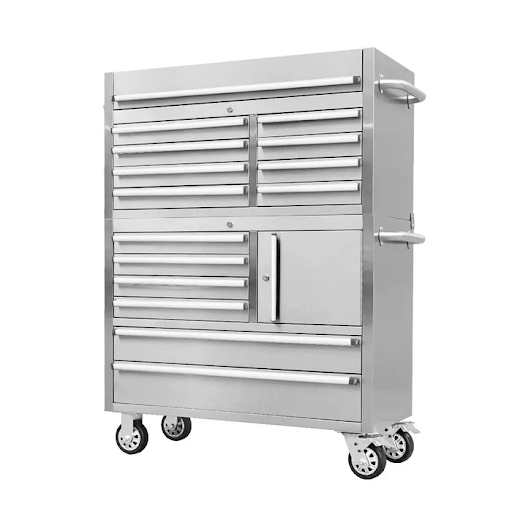
Why Tool Chest Drawer Ratings Assume an Evenly Spread Load
Storage units are compared on drawer count and total capacity, and both figures hide the number that matters. Each drawer rides on a pair of slides with a published rating, and that rating carries an assumption about how the load sits. A stainless steel tool chest cabinet holds what the slides hold, and the slides were tested with weight distributed evenly from front to back.
What the published figure describes
A hundred pound slide pair is tested with the load spread across the full extension, usually over a specified number of open and close cycles, which makes the published figure a fatigue rating as much as a strength one.
Concentrate that same hundred pounds at the front of a fully extended drawer and the bearings at the outer end of the slide carry a far larger share. Nothing breaks immediately; the drawer develops a droop, then a notchy feel, and eventually it stops closing square.
Where the weight belongs
Heavy items go low and at the back. That is the opposite of how most people load a chest, because heavy things are reached for most and drift to the front of the top drawers.
Ball bearing slides tolerate this better than roller slides, and neither tolerates it indefinitely. A sensible division is sockets and wrenches low, measuring and hand tools high, with the top drawers left for things that are light and frequently used.
Two drawers open at once is a different machine
A tool chest is stable because its weight sits inside its footprint. Opening a loaded drawer moves part of that weight outside the footprint, and opening two moves considerably more. Most units include an interlock that permits only one drawer at a time for exactly this reason. Where there is no interlock, the habit has to supply it, particularly on a rolling tool chest where the casters remove the friction that would otherwise resist a tip.
Casters and the floor they run on
Caster rating is per caster and assumes the load is shared evenly. A chest crossing an expansion joint briefly puts most of its weight on two wheels, which is where bent stems and flattened treads come from.
Larger diameter wheels cross gaps and debris that small ones catch on. Locking at least the two casters at one end before opening a drawer is the step that keeps a loaded cabinet where it was left.
What stainless actually resists
Stainless does not mean rust proof. The alloy forms a passive chromium oxide layer, and that layer handles humidity and spilled coolant well. It handles two things poorly, and neither is water. Chlorides are the first. Road salt carried in on parts, and some cleaning products, attack the passive layer locally and produce pitting rather than a general rust film. The second is contamination: steel particles from grinding or from a wire brush embed in the surface and rust there, which reads as the cabinet rusting when it is the debris on top of it.
Keeping the finish honest
Three habits cover it:
- Wipe salt and coolant off the same day
- Never clean stainless with a steel wire brush
- Use a non chloride cleaner on the surfaces
Brushed finishes hide fingerprints better than polished ones, and they hold dirt in the grain in exchange. Wiping along the grain rather than across it keeps the surface looking even, which is the whole reason a brushed tool chest still looks presentable after a year in a working shop.
Depth, drawer height and what actually fits
A forty one inch cabinet is wide enough for most wrench sets laid flat, and the depth is what decides whether a power tool case fits inside. Drawer height is the specification that gets overlooked, because a tall tool in a shallow drawer wastes the whole drawer. Counting fourteen drawers tells you very little without the heights. Two deep drawers are worth more than four shallow ones to anyone storing cordless tools, and the opposite is true for someone storing sockets.
Liners, and why they are not just tidiness
A drawer liner stops tools sliding on every open and close, and that sliding is what wears both the tools and the drawer bottom. It also keeps steel off steel, which matters more in a stainless cabinet than people expect.
Closed cell foam or rubber matting both work. Fitted foam inserts go further by showing at a glance what is missing, which is the real argument for them in a shop where tools leave the cabinet and come back.
Reading past the drawer count
Drawer count, total capacity and overall dimensions are the comparison figures. Slide type, per drawer rating, interlock arrangement and caster size describe whether the cabinet is still rolling smoothly in five years. TMG Industrial builds this one as a fourteen drawer stainless unit in its Pro Series range. Loading it heavy at the bottom and back, from the first day rather than after the first sagging drawer, is what makes the published ratings mean something.