

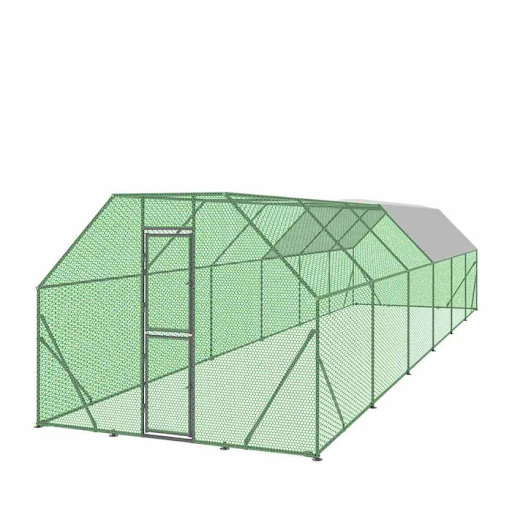
Backyard flocks have become common across Australian suburbs and small properties, and so have the foxes, birds of prey, and stray dogs that treat them as an easy meal. A chicken coop run that gives hens room to roam is only useful if it also keeps those visitors out, so the sensible way to judge any chicken enclosure is to start with how it can fail rather than how much space it offers.
Predators Attack from Four Directions
A predator can come over the top, through the walls, under the base, or through the door. Overhead cover stops birds of prey and climbing animals, mesh stops animals that push or reach through, a secure lower edge stops digging, and a latch protects the one opening that is used every day.
Each route needs its own defence, and the whole run is only as secure as the weakest of them. The comparison is a chain: strengthen three links and leave one thin, and the chain still breaks at the thin one.
Mesh and Fixings Decide What Gets Through
Hexagonal wire mesh is light and flexible, which makes it easy to fit but also means it can be pulled or pushed if it is poorly attached. The mesh on the TMG-CRS1040 is coated with polyvinyl chloride over the wire to resist rust, but the coating matters less than how the mesh is fixed to the frame.
A gap at a corner or along the base can be wider than any hole in the mesh itself. When checking a new chicken enclosure, look at every join and fixing point, because a determined animal tests the edges rather than the middle of a panel.
Height and Cover Change How the Keeper Works
The run stands 2 metres high, which means an adult can walk in, stand upright, and carry feed or water without stooping. That changes daily work more than it might seem, because cleaning, collecting eggs, and repairs are all quicker when the keeper is not bent double inside a low chicken enclosure.
A polyethylene tarp cover gives partial shade and keeps some rain off. In Australian summers, shade matters because hens pant and drop their feed intake in heat, but partial cover leaves the sides open so air still moves through the run.
Space per Bird Sets Hygiene as Well as Welfare
The footprint is 3 metres by 12 metres, which gives 36 square metres of enclosed ground. That figure is a ceiling, not a recommendation for flock size. How many birds it can hold comfortably depends on the breed, whether the hens also free range, and the welfare guidelines that apply where you live.
An overcrowded run turns to mud and manure quickly, which raises the risk of disease and feather pecking. It is also worth checking with the local council, because rules on keeping poultry, including flock size and distance from boundaries, vary between areas.
The Gate Is the Busiest and Weakest Point
The lockable gate is 60 centimetres wide and 170 centimetres high, and it is opened more often than any other part of the structure. Because it is used daily, it is also the part most likely to be left unlatched by accident, so the habit of checking it matters as much as the lock itself.
A short routine keeps the whole structure honest, and it takes only a few minutes once a week or after any storm that might have moved the run or loosened a fixing, so it is worth building the habit early:
- Corners: check fixings and gaps at each join
- Base edge: look for digging or loose mesh
- Gate: confirm the latch is closed and locked
- Cover: check the tarp for tears and pooled water
A Sound Frame Starts with Level Ground
The frame is galvanised steel with a powder coating, which resists rust better than bare steel in wet or humid conditions. Even so, the structure should stand on level, well-drained ground, because water pooling around the base speeds up wear and turns the run into a bog after heavy rain.
Place it so the cover shades the part of the run where the hens rest during the hottest hours, and keep feed under cover so it does not attract rodents. Setting up the run with these points in mind is easier than correcting them after the flock has moved in.
Planning Around the Weakest Link
More households are keeping hens, and that is likely to push buyers toward runs designed with predators in mind rather than appearance alone. Any chicken enclosure is worth judging by its gate, its corners, its base, and its cover, since those are the places where a flock is most often lost. TMG Industrial supplies this chicken run design for keepers who want a roomy walk in chicken run that is easy to maintain.