


| QUICK ANSWEREvaluating an LLM means deciding what “good” means in numbers before you ship: accuracy on your own data, hallucination rate, latency and cost. Measure against a gold dataset of human-verified answers, scale with an LLM judge scoring against a rubric, and keep human review in the loop to check the automated scores. Then keep measuring after launch – a model that passed last month can quietly fail this month. |
The demo always works. That’s the trap.
An LLM feature looks brilliant in the meeting where you show it off. Then it reaches production and starts inventing policy details, contradicting itself between one conversation turn and the next, or quietly getting worse after a routine model upgrade nobody thought to re-test. The gap between “it seemed to work” and “we can trust it” is where a lot of AI products quietly die, and the discipline that closes that gap is evaluation. Evaluation is the unglamorous work of turning a gut feeling into a number. It’s how you go from “the demo was impressive” to “we measured this against defined criteria and here’s how it performed.” Skipping it is how you ship a liability instead of a product, and a striking share of teams still ship with no real evaluation at all. Here’s what evaluating an LLM properly actually involves.Four things you’re measuring, not one
Accuracy, hallucination, latency and cost — and the trade-offs between them People talk about whether a model is “good,” as if that were a single quality. In production it’s at least four separate questions, and a model can pass one while failing another. Accuracy is the obvious one: does it give correct, relevant answers to the questions your users actually ask? Note the second half of that sentence. A model that scores well on a generic benchmark can still be wrong on your specific domain, because a published benchmark only predicts real performance when it tests tasks like yours and hasn’t been saturated or contaminated by training overlap. Your own test set beats a leaderboard every time. Hallucination is accuracy’s dangerous cousin: how often does the model state something false but plausible with complete confidence? This is the failure mode that hurts most, because the output sounds right. A model can be accurate on average and still hallucinate badly on the edge cases that matter. Latency is the one teams underestimate. Even a highly accurate system fails commercially if it’s too slow to use, and response time shapes retention more than most teams admit. Cost is the last, and it scales in ways that surprise people. Inference that’s cheap in a pilot becomes a serious line item at production volume, and a system that’s accurate but uneconomical isn’t shippable either. You’re optimizing all four at once, and improving one often costs you another. FOUR MEASUREMENTS, NOT ONE VERDICT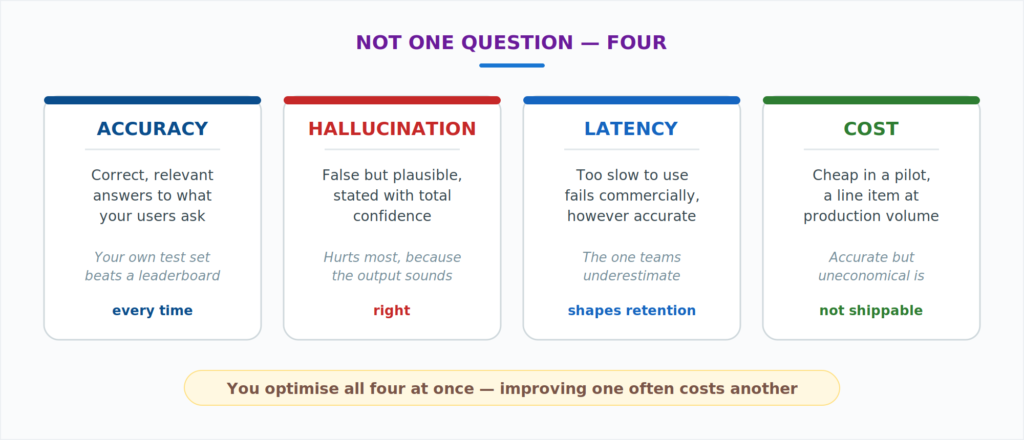
How teams measure it in practice
Gold datasets, LLM judges and human review — layered, not chosen between There’s no single method that covers everything, so mature teams layer three approaches. Start with a gold dataset — a set of representative questions paired with human-verified answers. This gives the cleanest signal, because you already know the right answer and can score against it directly. The cost is upkeep: the dataset has to grow and stay accurate as your product evolves. It’s worth it anyway, because it’s the closest thing to ground truth you’ll have. For scale, teams increasingly use an LLM as a judge — one model scoring another’s outputs against a rubric. It correlates reasonably well with human judgment and adapts across tasks with a prompt change, which makes it the practical default for day-to-day scoring. It isn’t infallible, so you keep humans in the loop to keep the automated scores honest against real user risk. And you keep human review in the mix for exactly that reason. A hybrid approach — automated scoring checked against human judgment — consistently beats automated-only evaluation. Tools exist for all of this now (RAGAS, DeepEval, LangSmith and others), but the tool matters less than the habit. HOW MATURE TEAMS LAYER THE THREE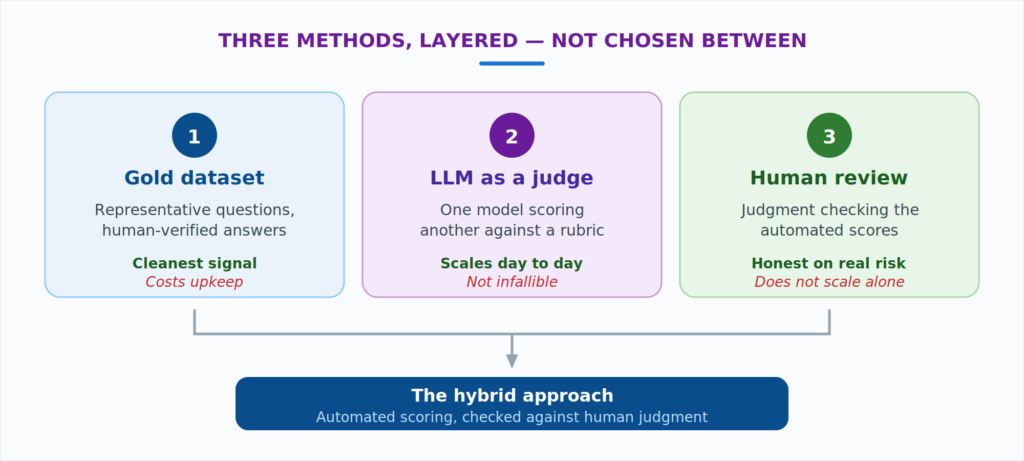
| METHOD | WHAT IT GIVES YOU | WHAT IT COSTS |
|---|---|---|
| Gold dataset | The cleanest signal — you already know the right answer and score directly against it | Upkeep: it has to grow and stay accurate as the product evolves |
| LLM as a judge | Scale, and adaptability across tasks with a prompt change | Not infallible — needs humans keeping the scores honest |
| Human review | The check that keeps automated scores honest against real user risk | Time and expert attention; it does not scale on its own |
Evaluation is not a one-time gate
Why shipped systems degrade quietly, and what continuous scoring looks like The biggest mistake is treating evaluation as a launch checkbox. You evaluate, you ship, you move on. Then the model provider pushes an update, or your data drifts, or usage patterns shift, and the system degrades silently — not with a crash, but with a slow slide nobody’s watching. Production LLM systems need continuous evaluation, the same way pipelines need monitoring. Score a sample of real traffic on an ongoing basis. Watch accuracy, hallucination rate, latency, and cost as live metrics, not a report you ran once. Set thresholds that page someone when a number crosses them. The whole point is to catch the silent degradation while it’s a small drift instead of a customer-facing failure. This is the kind of ongoing rigor that separates serious generative AI For Business Transformation from a one-off proof of concept. CONTINUOUS EVALUATION, NOT A LAUNCH GATE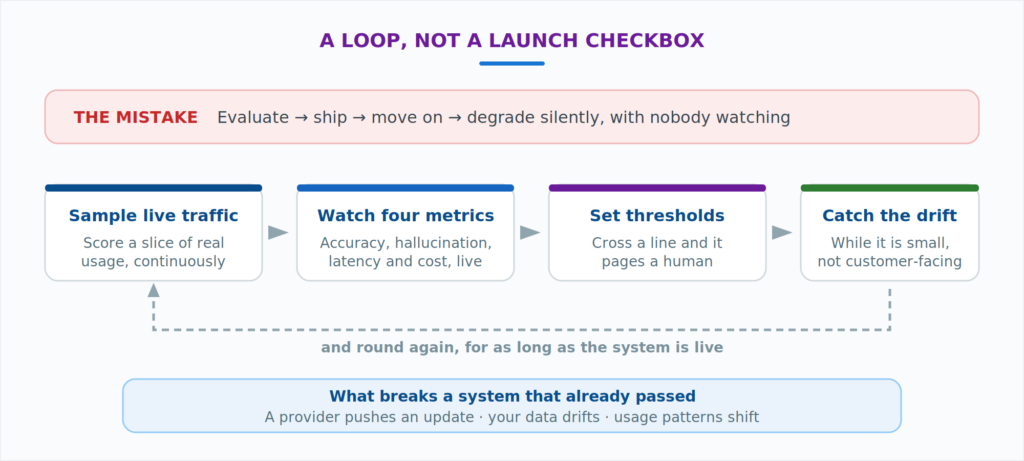
Conclusion
What to decide before you ship, and what to keep measuring after Before you ship an LLM feature, decide what “good” means in numbers – accuracy on your data, hallucination rate, latency, and cost – and measure against a gold dataset with automated scoring checked by humans. Then keep measuring after launch, because a model that passed last month can quietly fail this month. The demo working proves nothing. A measured, repeatable evaluation is the difference between an AI feature you hope works and one you can defend. The teams pulling ahead treat evaluation as core AI Product Engineering Services, not an afterthought – because trusting a system you haven’t measured is just optimism with a budget attached.| KEY TAKEAWAYS | |
| 1 | “Good” is at least four numbers: accuracy, hallucination, latency and cost |
| 2 | Your own test set beats a public leaderboard every time |
| 3 | Layer gold dataset, LLM judge and human review — hybrid beats automated-only |
| 4 | Keep measuring after launch: a model that passed last month can fail this month |