

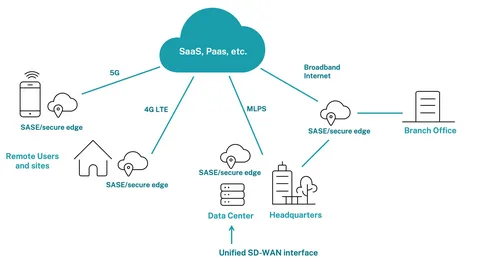
Strip away the acronym sprawl and a converged architecture rests on five services doing distinct jobs. Vendors bundle them differently, name them inconsistently and price them in varying combinations, which makes comparison harder than it should be. Understanding each one separately is what lets a buyer tell a genuine gap from a duplicate purchase. The five below are ordered the way most deployments sequence them, from the connectivity underneath to the visibility that makes the whole thing operable once it is live.
1. Secure Connectivity and SD-WAN Path Selection
The foundation decides how traffic leaves a site and which path it takes. Software-defined connectivity steers by application rather than destination address, and fails over between broadband, fibre and mobile links without dropping sessions. The essential SASE services for enterprises begin here for a practical reason: security delivered over a poorly chosen path still feels slow to the user, and perceived slowness is what drives people to request exemptions.
Local egress matters as much as path selection. If traffic still travels to a central site before reaching the internet, the architecture has relocated the bottleneck rather than removed it. Branch hardware does not have to disappear on day one; it can keep handling local segmentation while inspection moves outward on its own schedule, which is usually dictated by the circuit contracts rather than by the security roadmap.
2. Zero Trust Access to Named Applications
The second service replaces network-level admission with per-application authorisation. Architecture guidance on application-level access models draws the distinction cleanly: traditional VPN and firewall access grants implicit trust once a user reaches the network, leaving lateral movement possible, whereas a user-to-application model connects people only to the services they are authorised to use while the underlying networks stay isolated and hidden from probing.
It is worth being equally clear about the limits. Per-application access raises the cost of an attack, improves the chance of detection and contains the damage when something does go wrong. It is not prevention, and treating it as a guarantee sets expectations no architecture can meet.
3. Cloud-Delivered Firewall, IPS and Web Filtering
The third service covers what used to live in a branch appliance stack: firewall policy, intrusion prevention and web filtering, applied at cloud enforcement points instead of on-site hardware. The gain is uniformity, since one rule set follows a user from office to home to hotel.
Two questions really decide whether an implementation is credible. First, feature parity with the hardware being replaced, because reduced protocol support or coarser segmentation tends to surface mid-migration. Second, decryption capacity measured with inspection fully enabled rather than in a throughput figure that quietly assumes it is off. Exemption handling deserves equal scrutiny, since certificate-pinned applications will need bypasses and every bypass is a permanent gap unless it is logged, owned and reviewed on a schedule.
4. DLP and CASB Protection for Cloud Application Data
Connectivity and access control govern who reaches what. The fourth service governs what moves once they are in: which files leave sanctioned applications, which external accounts receive them, which integrations hold standing permissions nobody reviewed. It combines visibility into cloud application activity with content-aware policy at the point of movement.
Calibration is the hard part. Tuned tightly it buries teams in false positives; tuned loosely it becomes a reporting tool nobody acts on. Budget a genuine tuning period against real traffic rather than treating deployment as the finish line. Start with the data types that carry the clearest regulatory consequence, then widen scope once the policy behaves predictably on known traffic. Running in monitor mode for the first few weeks gives a realistic picture of how often each rule fires before anyone has to defend a block to a frustrated business owner.
Inline vs API-Based Controls for Cloud Application Data
| Dimension | Inline control | API-based control |
| Where it sits | In the traffic path at the edge | Connected to the SaaS tenant |
| Timing | Blocks in real time | Inspects after the fact |
| Covers | Sessions passing the enforcement point | Data already stored in the tenant |
| Blind spot | Traffic that bypasses the edge | Nothing is prevented, only found |
| Typical use | Stopping uploads and risky destinations | Finding historic over-sharing |
| Deployment effort | Agent or tunnel coverage | Tenant permissions per application |
5. Unified Visibility and Performance Monitoring
The fifth service is the one most often deferred and most regretted. Once enforcement sits in a provider’s cloud, a complaint about a slow application has four plausible causes and no obvious owner. Telemetry that measures the whole path, from endpoint through enforcement point to application, is what turns that argument into a diagnosis.
Resilience is increasingly treated as an organisational obligation rather than a technical nicety, and the global assessment of national cyber capability frames building trust in digital systems as a priority that countries are measured against. Demonstrating that your own controls work requires evidence, and evidence comes from instrumentation decided at design time. Agree what acceptable performance means before migration, so the measurements afterwards have a baseline for comparison.
How to Sequence SASE Services in a Rollout
Deploying all five simultaneously is how programmes stall. A workable order:
- Access control first, because legacy remote access is the weakest link and users feel the improvement immediately
- Connectivity next, timed to circuit renewals rather than forced early
- Threat inspection once enforcement points are proven in your regions
- Data protection after that, with time allocated for tuning
- Visibility configured alongside each stage, never retrofitted at the end
The order is not arbitrary. Each stage depends on entitlement and inventory work done in the one before it, which is why programmes that run stages in parallel tend to discover the same missing data four times over.
Conclusion
These five services are not a checklist to buy wholesale. Most organisations already run three of them in some form, and the valuable exercise is mapping what exists against what the architecture assumes before any negotiation starts. Where they genuinely differ from the fragmented tools they replace is in sharing one policy engine and one telemetry stream, which is also the part that cannot be added later. Judge platforms on that, and treat the rest as detail to verify during a trial.
Frequently Asked Questions
Can SASE services be bought from different providers?
Yes, and plenty of organisations do. The cost is policy coordination between vendors, which is the same fragmentation problem convergence was meant to solve, so the saving should be clearly worth it.
Which of the five SASE services delivers value fastest?
Access control, almost always. It addresses the weakest trust model in most estates and produces a visible improvement for remote staff within weeks rather than quarters.
Is data loss prevention necessary for smaller organisations?
It depends on what data you hold rather than headcount. Organisations handling regulated personal or financial data need it regardless of size, though scope can start narrow and expand.
How long should a full SASE rollout take?
Phased programmes typically span several quarters. Anything promising completion in weeks is either very narrow in scope or deferring the tuning and verification work into production. Scope creep is the usual cause of overrun, so fix the boundaries early and in writing.