

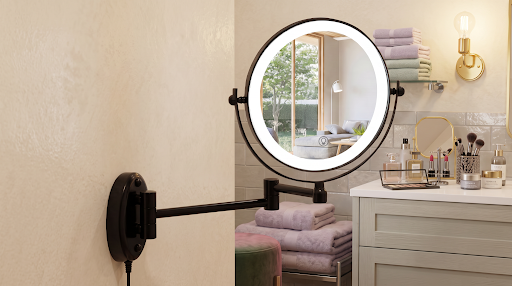
A good makeup mirror does more than provide a reflection. The right combination of magnification, lighting, viewing angle, size, and mounting position can make detailed grooming and makeup application considerably easier. Unlike a countertop mirror, a wall-mounted makeup mirror stays in a fixed location and leaves the vanity or bathroom counter open for other essentials.
In the U.S. market, common designs include illuminated mirrors, magnifying mirrors, double-sided models, swing-arm mirrors, rechargeable units, and hardwired bathroom mirrors. Retail search results also show that shoppers frequently compare options based on magnification levels such as 5X and 10X, LED lighting, mounting style, and adjustability.
Choosing between these features is less about finding the mirror with the most functions and more about matching the mirror to the way you actually use it.
An Overview on Wall-Mounted Makeup Mirror
A wall-mounted makeup mirror is designed to attach directly to a wall rather than sit on a countertop. Most models are relatively compact and position the reflective surface close enough to the face for detailed tasks such as applying eyeliner, blending concealer, shaping eyebrows, shaving, or performing skincare routines.
Many bathroom versions use an articulated or swing arm. The arm allows the mirror to extend away from the wall when needed and fold closer to the wall afterward. Some models also swivel or rotate, making it possible to change the viewing angle without moving the mounting hardware. Current U.S. retail listings include both fixed and articulated designs, with some models offering substantial arm extension and rotating mirror heads.
This configuration is particularly useful when several people use the same bathroom because the mirror can be repositioned without taking up permanent counter space.
Magnification: 1X, 5X, 7X, or 10X?
Magnification is one of the most important specifications to understand before choosing a makeup mirror.
A 1X mirror provides a normal reflection without intentional enlargement. It is generally appropriate when you want to see your overall face rather than inspect small areas closely.
Higher magnification enlarges facial details. Five-times magnification, for example, can make tasks such as eyebrow shaping, eyeliner application, and shaving easier to see. Ten-times magnification provides considerably more detail but also produces a narrower field of view and can make the reflection feel less natural.
U.S. retailers currently offer wall-mounted models with a wide range of magnification options, including 5X, 8X, and 10X, as well as dual-sided mirrors combining 1X with a magnified surface.
For everyday use, a dual-sided or 1X/magnified configuration can be more versatile than choosing a highly magnified mirror exclusively. The normal side helps with general grooming, while the magnified side is available when greater detail is necessary.
Why Very High Magnification Isn’t Always Better
It is easy to assume that more magnification means a better mirror. That is not necessarily true. As magnification increases, the usable viewing area becomes smaller and positioning becomes more important. A high-power mirror can be useful for very detailed work but may be frustrating if you are trying to see your entire face.
For that reason, magnification should be treated as a task-specific feature rather than a quality ranking.
LED Lighting and Makeup Application
Lighting can be just as important as the reflective surface itself. A mirror positioned in a bathroom with overhead lighting may create shadows beneath the eyes, nose, and chin. That can make it harder to judge foundation, concealer, contour, or color accurately.
LED makeup mirrors address this by placing illumination around or near the reflective surface. Current U.S. listings include models with integrated LED lighting, dimming controls, rechargeable power, USB charging, batteries, and conventional plug-in power.
Some illuminated mirrors also offer multiple color-temperature settings. These can be useful when you apply makeup for different environments because bathroom lighting, daylight, and indoor lighting can have noticeably different appearances.
However, brighter is not automatically better. Excessive brightness can create glare and make close-up work uncomfortable. A dimmable light gives you more control over the viewing environment.
What Does Color Temperature Mean?
Color temperature describes the visual character of white light and is commonly expressed in Kelvin (K). Warmer light generally has a softer, more yellow appearance, while cooler light appears whiter or slightly bluish. Neutral light sits between those extremes. For makeup application, the important issue is consistency. If you apply makeup under very warm bathroom lighting and later enter bright daylight, colors can appear different. A mirror with adjustable lighting can therefore be useful for people who regularly move between different lighting environments. Some current products specifically advertise multiple lighting modes or adjustable illumination.
Double-Sided vs. Single-Sided Mirrors
Single-sided mirrors are straightforward: one reflective surface faces the user. Double-sided designs typically place two reflective surfaces back-to-back on a rotating head. One side may provide standard 1X reflection while the other provides magnification.
This design is common among swing-arm bathroom mirrors because rotating the head allows the user to switch between normal and magnified viewing without installing a second mirror. Retail listings in the U.S. show numerous dual-sided configurations, including 1X/5X and 1X/10X options.
For households where the mirror serves several purposes, this flexibility can be more practical than having a single magnification level.
Swing-Arm and Adjustable Designs
The mounting mechanism affects how useful the mirror is in everyday life. A fixed mirror remains in one position. This can work well when the mirror is installed at exactly the right height and distance. An adjustable swing-arm mirror provides considerably more flexibility. The user can pull the mirror closer, move it sideways, tilt it, or fold it back toward the wall when finished.
Some current bathroom mirror designs use pivoting arms that allow the mirror head to move several inches or more from the wall. The additional movement is particularly helpful when the mirror is shared by people of different heights.
How High Should a Makeup Mirror Be Mounted?
There is no universal mounting height because bathroom layouts and user heights differ. The most practical approach is to determine the position from the person’s face rather than simply measuring from the floor. When seated at a vanity, the mirror should be positioned so the reflective center is approximately aligned with the user’s face during normal use.
For a standing application, the mounting position should similarly account for the user’s normal standing height.
Before drilling, temporarily position the mirror against the wall and test the viewing angle. This simple step can prevent a common installation problem: placing the mirror at a technically convenient height but an inconvenient viewing position.
Choosing the Right Mirror Size
Makeup mirrors are generally smaller than full bathroom vanity mirrors because they are intended for close-up viewing. An 8-inch round mirror, for example, provides a compact viewing area while remaining relatively unobtrusive. Larger models provide a broader field of view but require more wall space.
The appropriate size depends on how close you normally work to the mirror. A small highly magnified mirror may be perfectly functional for detailed tasks, while a larger mirror can be preferable when you want a more natural view.
Current U.S. listings range from compact approximately 8-inch wall-mounted mirrors to substantially larger illuminated vanity-style designs.
Plug-In, Hardwired, Battery, or Rechargeable?
Power source is another practical consideration. Battery-powered mirrors are generally convenient where electrical wiring is unavailable. Rechargeable models reduce the need for disposable batteries and can be moved or repositioned more easily.
Plug-in mirrors provide a continuous power source but require the cord and outlet to be accommodated in the installation.
Hardwired models create a cleaner appearance because the electrical connection is concealed, but installation involves electrical work and should comply with applicable local electrical requirements. Bathroom electrical installations also require appropriate consideration of moisture exposure and applicable codes.
Current U.S. products use all of these approaches, including battery, USB, adapter, and hardwired configurations.
Bathroom Installation and Moisture
A bathroom is a humid environment, so the mirror’s construction and installation location matter. A mirror intended for a bathroom should be appropriate for the environment in which it will be installed. Electrical components deserve particular attention because moisture and electricity create a safety concern.
Do not assume that an illuminated mirror is automatically suitable for installation directly inside a wet area simply because it is marketed as a bathroom mirror. Check the manufacturer’s installation instructions, electrical specifications, and any applicable product rating.
The wall itself also matters. Anchoring hardware should be appropriate for the substrate, whether that is drywall, tile, masonry, or another surface.
Glass Quality Matters
Magnification and lighting receive most of the attention, but the reflective surface remains the foundation of the mirror.
Quality optical glass can provide a clearer and more consistent reflection. Distortion becomes particularly noticeable when the mirror is used at close range because the user is examining small facial details.
The reflective coating and protective backing also contribute to long-term performance. Proper manufacturing and edge finishing can reduce the likelihood of premature deterioration, while appropriate cleaning helps maintain the reflective surface.
Avoid abrasive cleaners and rough materials that can scratch or damage the mirror surface or surrounding finish.
Wall-Mounted vs. Countertop Makeup Mirrors
The main difference is not simply appearance; it is how the mirror fits into the user’s routine. A countertop mirror can be moved wherever it is needed, making it useful for renters, bedrooms, travel, or shared spaces. It can also be stored when not in use.
A wall-mounted design provides a permanent location and keeps the countertop clear. It can also be paired with an adjustable arm so the mirror remains accessible without occupying valuable vanity space.
For a dedicated bathroom vanity, wall mounting can make sense when the mirror will be used frequently. For someone who frequently changes locations, a portable countertop mirror may be more practical.
Common Mistakes to Avoid
One of the biggest mistakes is selecting magnification before considering how the mirror will actually be used. A 10X mirror may sound impressive, but it can be unnecessarily restrictive for general grooming.
Another mistake is ignoring lighting. A high-quality reflective surface cannot completely compensate for poor illumination.
Mounting location is another frequent problem. Installing the mirror without testing the viewing angle can result in a mirror that is technically accessible but uncomfortable to use.
Finally, do not overlook installation requirements. Weight, wall construction, fasteners, electrical connections, and proximity to water should all be considered before installation.
How to Choose the Right Wall-Mounted Makeup Mirror
Start with the task rather than the feature list. If you mainly need detailed eyebrow, eyeliner, shaving, or skincare work, magnification deserves significant attention. If color accuracy and visibility are the priority, focus on lighting quality and adjustable brightness or color temperature.
For shared bathrooms, an adjustable arm and dual-sided design can provide greater flexibility. For a minimalist vanity, a compact model with concealed or rechargeable power may reduce visual clutter.
The goal is not to find a mirror with the maximum number of specifications. It is to find the combination of optical quality, magnification, lighting, size, adjustability, mounting, and power that matches the way you use the space.
A well-chosen wall-mounted makeup mirror should make close-up grooming easier without becoming another inconvenient fixture in the bathroom. When those basic factors are evaluated together, the decision becomes much simpler: choose the magnification you actually need, the lighting you can control, the size that fits your space, and the mounting system that works comfortably at your normal viewing position.
A relaxed corner with good light and a comfortable chair deserves a great drink to go with it. If you are curious about popular drinks and typical sizes from this coffee chain, dutchbrosmenupricess.com brings the details together in one place.