

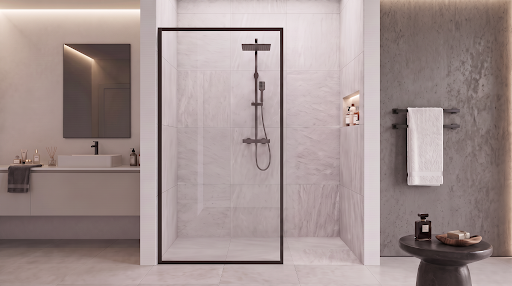
A shower door can remain functional for years, but that does not mean it should remain in service indefinitely. Corroded hardware, damaged glass, leaking seals, loose frames, and outdated door designs can all signal that it is time to consider a framed fixed glass shower door replacement.
For homeowners, the challenge is determining whether the problem requires a complete replacement or simply a new seal, hinge, roller, handle, or piece of glass. That distinction matters because replacing an isolated component can be considerably simpler than rebuilding the entire shower enclosure.
A framed fixed glass door replacement is generally considered when the existing stationary glass panel or surrounding frame has become damaged, deteriorated, difficult to maintain, or incompatible with the rest of the shower enclosure. Understanding the construction of the existing system before ordering anything can prevent expensive measurement and installation mistakes.
Framed Fixed Shower Door Explained
A framed shower door uses a metal frame around some or all of the glass. The frame provides structural support and creates mounting surfaces for hardware, seals, and adjacent panels.
A fixed shower panel, by contrast, is a stationary piece of glass that does not swing or slide. It may work alongside a hinged or sliding shower door to form a larger enclosure.
These two characteristics can exist together. A shower enclosure may therefore contain a framed stationary glass panel next to an operating door.
This is different from a frameless shower enclosure, where thicker glass and specialized hardware allow much of the supporting metal framework to be eliminated. Semi-frameless designs occupy the middle ground, using metal framing in selected areas while leaving portions of the glass exposed.
The construction style matters because replacement glass, hardware, mounting methods, and measurements are not necessarily interchangeable between framed and frameless systems.
Signs That Your Shower Door Needs Replacement
Not every shower-door problem means the glass itself has failed. Some problems are relatively inexpensive to correct, while others justify replacement.
Cracked or Damaged Glass
Cracks, chips, deep scratches, or significant edge damage deserve immediate attention. Shower glass is safety-critical, and damage can compromise its structural integrity.
Tempered glass is designed to break into relatively small granular pieces when it fails rather than producing large sharp shards. However, tempered glass should never be considered safe to continue using once it has visible structural damage.
If a stationary panel is cracked, replacing the affected panel is generally more appropriate than attempting to repair the glass.
Corroded or Damaged Frames
Metal framing is constantly exposed to water, soap residue, humidity, and cleaning chemicals. Over time, aluminum and other metals can discolor, pit, corrode, or develop surface deterioration.
Minor oxidation may be cosmetic. Severe corrosion around fasteners or structural connections is a different matter. If the frame can no longer securely hold the glass or hardware, replacement becomes a safety and installation issue rather than merely an appearance upgrade.
Persistent Water Leakage
A small amount of water escaping around a shower door does not automatically mean the entire enclosure needs replacement.
Leaks can result from worn vinyl seals, incorrect door alignment, deteriorated caulk, clogged drainage paths, or gaps between panels. Replacing the appropriate seal or correcting alignment may solve the problem.
However, persistent leakage combined with deteriorated framing, damaged glass, or movement in the enclosure may indicate a larger installation problem.
Loose or Misaligned Panels
A stationary shower panel should not move significantly when properly installed. Movement can indicate loose fasteners, deteriorated setting materials, frame problems, or incorrect installation.
Do not assume that tightening visible screws will solve the problem. Glass enclosure components must be supported correctly, and improper adjustments can create additional stress on the glass.
Replacement Glass vs. Complete Shower Door Replacement
One of the most important decisions is whether to replace only the damaged glass or the entire shower door system.
If the existing frame remains structurally sound and compatible with replacement glass, replacing a single panel can make sense. This approach may preserve the existing layout, hardware, and surrounding enclosure.
A complete replacement becomes more reasonable when multiple components have deteriorated or when the existing system has become difficult to maintain.
For example, replacing an old stationary panel while retaining a badly corroded frame may solve the immediate glass problem but leave the underlying issue untouched.
The condition of the surrounding walls, tile, threshold, hardware, seals, and other glass panels should therefore be evaluated before making a decision.
How Shower Door Measurements Affect Replacement
Accurate measurements are one of the most important parts of replacing shower glass.
A replacement panel is not necessarily the same size as the opening itself. The required glass dimensions depend on how the panel sits inside the frame, how much clearance is required, the type of mounting system, and whether seals or channels are involved.
Measure the opening at multiple points rather than assuming that a shower opening is perfectly square. Walls and tile surfaces can vary slightly from top to bottom.
The existing glass thickness should also be identified. Common shower-glass thicknesses include 1/4-inch, 5/16-inch, and 3/8-inch, although the appropriate thickness depends on the enclosure design and manufacturer’s specifications.
Do not order replacement glass solely by measuring the old piece and copying its dimensions without understanding how it was installed.
What Type of Glass Is Used for Shower Doors?
Safety glazing is a fundamental consideration for shower enclosures. Tempered glass is commonly used because it is heat-treated to increase its strength compared with ordinary annealed glass and is designed to fracture into smaller pieces if it breaks.
Laminated glass is another safety-glazing option, although it is less common in typical residential shower-door applications.
Building codes and safety-glazing requirements can vary based on location, glazing position, and enclosure configuration. In the United States, homeowners and contractors should verify applicable requirements rather than assuming that any glass product is acceptable for a shower installation.
Glass should also be appropriately processed before tempering. Tempered glass generally cannot be cut, drilled, or significantly modified after the tempering process because doing so can cause the panel to fail.
Framed vs. Frameless Shower Doors
The choice between framed and frameless shower doors often comes down to enclosure design, structural requirements, maintenance preferences, and aesthetics.
Framed systems typically use thinner glass because the surrounding metal framework provides additional support. They can be practical for traditional bathrooms and may offer a straightforward replacement path when the existing enclosure is still structurally sound.
Frameless systems use heavier glass and specialized hardware to create a cleaner appearance with less visible metal. They can make a bathroom feel more open, but installation tolerances and hardware requirements can be more demanding.
Neither design is automatically better for every bathroom. The right choice depends on the enclosure’s dimensions, wall conditions, glass requirements, budget, and desired appearance.
How Much Does Shower Door Replacement Cost?
There is no single replacement price because the project can range from replacing a seal or hardware component to rebuilding an entire enclosure.
The biggest cost variables typically include glass size and thickness, glass type, edge finishing, holes or cutouts, frame condition, hardware, installation complexity, and local labor rates.
A simple stationary panel replacement is fundamentally different from replacing an entire framed enclosure with new glass, framing, hardware, and installation.
Labor can also become more significant when the existing enclosure has to be removed carefully, surrounding tile needs repair, or the opening is out of square.
For an accurate estimate, homeowners should obtain measurements and identify the existing enclosure configuration before comparing quotes.
Can You Replace Only the Fixed Panel?
In many situations, yes. A stationary panel can potentially be replaced without replacing the operating shower door.
The feasibility depends on how the enclosure was constructed. The replacement glass must fit the existing frame or channel, match the required thickness, and accommodate any holes, notches, or hardware locations.
The existing frame also needs to be in acceptable condition. Installing new glass into a severely deteriorated frame can undermine the purpose of the replacement.
Before ordering, inspect the channels, fasteners, seals, brackets, and surrounding glass. If several components are failing simultaneously, a complete enclosure assessment may be more practical.
Common Mistakes During Shower Door Replacement
The biggest mistakes usually happen before installation. One common error is measuring only one location. Shower openings can vary because walls, tile, and framing are not always perfectly square.
Another mistake is assuming that the replacement glass can be modified after tempering. Because tempered glass generally cannot be cut or drilled afterward, all required dimensions and fabrication details need to be established beforehand.
Homeowners also sometimes overlook hardware compatibility. A panel may have the correct overall dimensions but still be unsuitable if the mounting system, glass thickness, holes, or channels do not match.
Finally, replacing glass without addressing the underlying cause of movement or leakage can result in the same problem returning.
When Professional Installation Makes Sense
Shower glass installation is not a good place to improvise. Large glass panels can be heavy and difficult to maneuver. Incorrect handling can damage glass edges, tile, frames, or hardware. Poor alignment can also create stress points and water-management problems.
Professional installation is particularly sensible when panels are large, the enclosure uses multiple glass pieces, the opening is irregular, or the existing frame has deteriorated.
Even when homeowners purchase replacement glass separately, having the installation evaluated by someone familiar with shower enclosures can reduce the likelihood of an expensive mistake.
How to Choose the Right Replacement Approach
Start by identifying exactly what has failed. If the glass is intact but a seal is leaking, replacing the seal may be enough. If hardware has failed but the frame and glass remain sound, hardware replacement may solve the issue.
If the fixed panel is damaged but the surrounding structure is sound, replacing the panel may be appropriate. If the frame, seals, hardware, and glass are all showing significant deterioration, replacing the complete system may provide a more reliable long-term solution.
The goal should not simply be to install new glass. The goal is to restore a properly supported, correctly sealed, code-compliant shower enclosure.
Final Considerations Before Ordering
Before purchasing replacement components, document the existing shower configuration. Record the glass thickness, panel dimensions, frame style, channel dimensions, hardware locations, and any visible damage.
Photographs can also help communicate the enclosure layout, particularly when discussing replacement options with a glass fabricator or installer.
Most importantly, do not treat shower-glass replacement as a simple matter of matching height and width. The interaction between glass, framing, hardware, seals, walls, and threshold determines whether the finished enclosure will function correctly.
A framed fixed glass shower door replacement can be a relatively straightforward repair when the existing frame and surrounding components remain sound. When several components have deteriorated, however, replacing only one piece may simply postpone a larger problem. Evaluating the entire enclosure first is usually the smarter approach.
Settling into a new home often means learning new roads, too. If you have moved to a new state and need to refresh your driving knowledge, a DMV Practice Test is a simple, free way to prepare for the permit or license exam.