

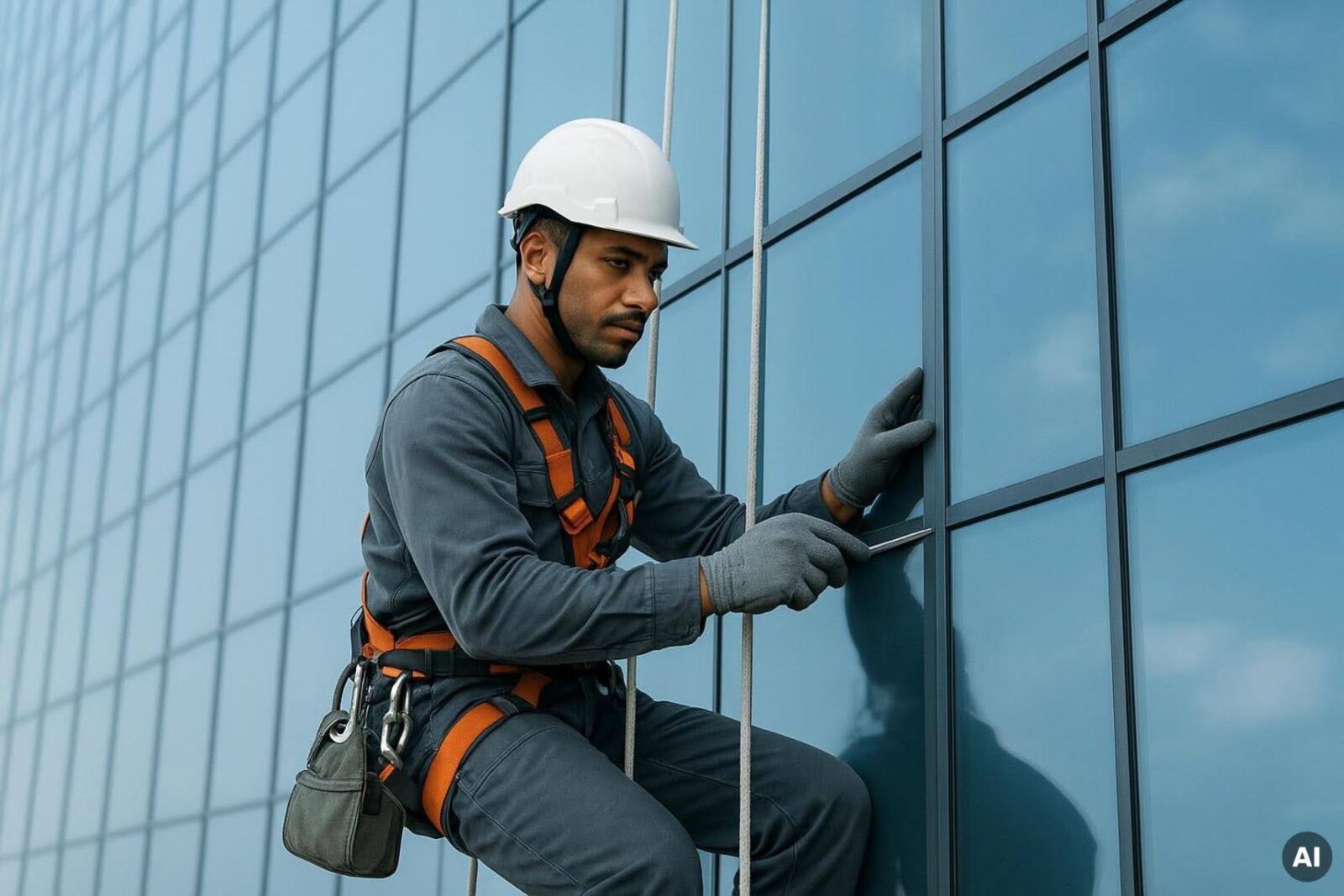
Abseiling is an efficient way to carry out high-level property maintenance because it avoids the large upfront cost, long setup time, and extensive street-level space required by traditional scaffolding and mobile elevated work platforms (MEWPs). Using certified anchor points and lightweight industrial rope systems, qualified technicians can get to work in a small part of the usual time. They can reach unusual parts of a building accurately and complete facade repairs or cleaning without closing roads or interrupting normal business activity.
Modern commercial and residential buildings often have detailed profiles, cantilevered overhangs, and delicate curtain wall glazing that cannot be reached easily with a standard cradle or boom lift. For property managers who must meet strict safety rules while controlling costs, choosing specialist abseiling building maintenance – comprehensive RAIL services provides focused exterior work that protects the building and keeps downtime very low.
Why Is Abseiling an Efficient Solution for High-Level Property Maintenance?
The main benefit of abseiling is its flexibility and low starting cost. With traditional facade work, access arrangements can use up one-third to one-half of the full project budget before any repair begins. Industrial abseiling avoids much of this expense by using the building’s own engineered features, such as certified roof anchors and davits, as the access system. This greatly reduces the need to transport and assemble large amounts of equipment.
Rope access also gives workers a high level of movement. Problems on a tall building may be spread across different areas, such as occasional mastic joint failures, small areas of crumbling concrete, or selected windows that need cleaning. Hiring suspended cradles or building scaffolding across the full elevation would not make financial sense in these cases. Abseiling lets teams carry out several quick drops and fix each issue where it appears, reducing work that could take weeks to a few days.
What Is Industrial Abseiling and Rope Access?
The public often uses the words “abseiling” and “rope access” to mean the same thing. Industrial rope access, however, is a skilled and closely controlled method of working at height. It was first adapted from offshore oil and gas work and vertical exploration. It has since become an international trade controlled by groups such as the Industrial Rope Access Trade Association (IRATA) and the Society of Professional Rope Access Technicians (SPRAT).
Industrial rope access does not involve simply hanging from one rope. It uses carefully planned systems, backup rigging, and specialist equipment for climbing and positioning. It provides a safe work method that allows tradespeople such as glaziers, painters, stonemasons, and structural inspectors to carry out their work on tall buildings, historic facades, stadiums, and transport facilities.
Why High-Level Buildings Benefit from Rope Access
Tall buildings, especially those higher than ten storeys or those with unusual shapes, create major access problems for facilities teams. Permanent Building Maintenance Units (BMUs) can cost a great deal to install, require regular mechanical servicing, and may break down, leaving parts of a facade without attention for months. Rope access fills this gap without the need for large mechanical equipment on the roof.
Abseiling also creates very little pollution compared with many other access methods. Technicians do not need diesel-powered crane booms, heavy transport vehicles, or powered access cradles. This lowers the noise and carbon emissions linked to maintenance work. For property managers working to meet environmental targets, rope access offers a quiet, low-impact choice that helps protect city air quality and keeps the surrounding area peaceful.
What Makes Abseiling More Efficient Than Scaffolding and MEWPs?
Traditional access methods, including steel scaffolding, mast-climbing work platforms, and MEWPs, use many resources. They may require several transport vehicles, ground permits, road closures, and days or weeks of assembly before a technician can begin. If the project runs late, equipment hire charges continue to grow and can place the maintenance budget under pressure.
Industrial abseiling works in a different way. Ropes, rigging equipment, and personal protective equipment can fit inside a van and can often be moved through a normal service lift. This simple setup allows contractors to arrive quickly, focus on specific building problems, and remove their equipment at the end of each shift. No large machinery needs to remain on site.
Reduces Setup Time and Labour Requirements
Scaffolding around a medium-rise or high-rise building can take weeks to erect. It often requires large teams to assemble many tonnes of steel tubes and timber boards. By comparison, a qualified rope access team can set up its lines, carry out safety checks, and start work within about an hour of arriving.
This shorter setup cuts the number of paid work hours. The building owner does not need to pay separate scaffolding crews to erect and remove the structure or cover long scaffold hire periods. Payment is focused on the trained technicians carrying out the maintenance. When the day’s work is complete, the lines can be removed quickly, leaving no unused equipment in place and reducing the early project costs.
Reaches Confined and Difficult Areas
Modern buildings often include curved surfaces, deep recesses, internal atriums, and large glass overhangs. Hydraulic boom lifts and scissor lifts are limited by the distance they can reach from the street. They commonly reach only around 45 to 50 metres and may not be able to pass through covered walkways or enter narrow courtyards where the ground cannot support heavy machinery.
Industrial rope access can reach unusual areas more easily. If technicians have strong overhead anchor points, suitable direction changes, and additional secure anchor points, they can move below cantilevered canopies, enter ventilation shafts, cross horizontal beams, and reach inner facades that a mechanical basket or platform cannot access.
Minimises Disruption to Occupants and Businesses
Scaffolding covered with protective netting can make rooms darker, hold dust against the building, and reduce natural light. This can annoy office workers and residents. Fixed scaffolding can also create security and privacy problems because it may give intruders a way to climb up and can leave private windows exposed to outside views for a long period.
Rope technicians work for short periods in each area. They descend, complete the task, and leave without putting a large frame outside the windows. The ground-level restricted areas are small and can be controlled with barriers and trained spotters. Ground-floor shops, hotel entrances, and pavements can usually stay open and usable while the work continues.
Which Property Maintenance Tasks Can Abseiling Cover?
Some people think industrial abseiling is limited to occasional window cleaning. In practice, rope access is a way for skilled specialists from several trades to reach a building. Qualified technicians may hold certificates in masonry, structural engineering, non-destructive testing, glazing repair, and industrial coatings.
Rope access specialists can work on historic lime mortar facades as well as modern structural silicone glazing. They can carry out a wide range of building envelope repairs. Industry guidance suggests that if facade repairs affect around 20% or less of an elevation, rope access can cost much less than installing access across the whole surface. It is well suited to small, localised defects.
High-Rise Window and Façade Cleaning
Facade cleaning is a basic part of building care. Air pollution, traffic dirt, and organic growth can spoil the appearance of a building. If they remain on curtain wall glass for too long, they may cause permanent marks. Rope access teams, like those at www.ropeaccessinlondon.co.uk, can clean commercial glazing efficiently, with typical output of about 700 to 1,000 square metres per day for each team.
For stone, brick, and metal cladding, technicians use specialist methods that work at low pressure. These include superheated water systems such as DOFF cleaning. This method can remove algae, bird droppings, and tough carbon deposits without harming delicate masonry. Gentle TORC systems use fine granules and compressed air in a controlled swirling action to remove surface deposits safely.
Cladding, Concrete and Structural Repairs
Weather gradually places stress on building facades. This can cause composite panels to separate, expansion seals to break down, and concrete to crumble because of carbonation. Suspended technicians can reach fine cracks, carry out tap tests to find areas that have separated, and apply anti-carbonation coatings or repair mortar at the affected points.
When failed double-glazed units or cladding panels need work, rope technicians can replace worn silicone seals around the edges, install made-to-measure flashings, and complete small mastic repairs. For limited glass replacement, they can use controlled lifting lines and suction equipment to keep the glass stable and protected during installation.
Gutter, Roof and Leak Detection Services
Blocked parapet gutters and damaged rainwater pipes can cause serious water entry, damaging interior plaster and electrical equipment. Rope access workers can move across sloping roofs, clear gutters, unblock downpipes, and secure loose flashings without the cost of a crane platform.
For difficult leaks, technicians carry out detailed testing. They can use controlled hose nozzles for focused water tests along with thermal imaging cameras, borescopes, and moisture meters. These tools help them follow the route of water through the building envelope and quickly identify broken seals or damaged cavity trays.
Why Are Roof Anchor Points Important for Abseiling?
Industrial rope access depends on strong overhead support. Unlike recreational climbers, who may attach ropes to natural features, industrial technicians use purpose-built and certified roof anchor systems. These anchors provide the structural support for every descent.
Anchor systems safely transfer movement and weight into the building’s main concrete, steel, or masonry structure. Since safety requirements allow very little room for error, the anchor system must meet strict rules covering its layout, the materials used beneath it, its regular care, and its inspection records.
Anchor Point Design and Installation
Anchor systems come in different forms based on the design of the building and the loads the structure can carry. They may include forged eyebolts, chemically fixed structural studs, horizontal fall-arrest and rope access tracks, counterweighted roof rigs, and cantilevered davit arms. Davits are especially useful on modern curtain wall facades. They hold the ropes out beyond the parapet, reducing the chance of the ropes pressing against or scratching flashing and glass edges.
Anchors must be placed carefully to reduce dangerous swinging if a technician slips while descending or changing position. Engineers position them to match the areas that need maintenance while following national and international load requirements. These systems are commonly designed to carry at least 12 to 15 kN under European and Indian rules, or 5,000 pounds (2,268 kg) per technician under North American OSHA rules.
Certification, Load Testing and Scheduled Reinspection
Under workplace safety rules, including UK Health and Safety Executive (HSE) guidance, European Standard EN 795, and OSHA Subpart D, building owners are legally responsible for the condition of their anchor equipment. Fitting the hardware is only the beginning. The anchors must pass commissioning pull tests and remain under regular compliance checks.
Rope access anchor points need a full visual check and physical re-certification at least every 12 months by a qualified testing professional. Inspection records, pull-test certificates, and identification tags must be kept safely and for the required period. If an anchor shows bending, chemical damage, or weakened resin bonding, it must be taken out of service at once so that working lines remain safe.
How Safe Is Abseiling for High-Level Property Maintenance?
To someone watching a technician suspended far above a busy city street, abseiling may look like an extreme activity. Industrial rope access is a professional work system with a strong safety record. In many cases, its rates of incidents and deaths compare favourably with scaffolding and powered access platforms.
This safety record comes from strict procedures developed over many years. Every technician follows set working methods. Possible single points of failure are reduced through backup systems, regular equipment checks, and ongoing checks by other team members.
Two-Rope Systems and Fall Protection Controls
The basic rule of professional rope access is the two-rope system. Each worker is connected to two separate lines with independent anchor points. The main working line supports the worker during ascent and descent. A second safety line uses a mobile fall-arrest device that locks if the working line loses tension.
Technicians wear strong full-body fall-arrest harnesses with back, chest, and front attachment points. Before each descent, the technician checks all equipment, including descenders, backup devices, ascenders, carabiners, and cow’s tails. A colleague then carries out a second check so that all safety features are correctly fitted and ready for use.
Weather, Falling Objects and Public-Safety Controls
Weather can create real dangers during work at height. Rope access procedures set limits for wind, temperature, and rain. Strong crosswinds can make a technician swing into parts of the facade. Rain can affect friction devices and increase the risk of cold-related illness. Work stops at once if bad weather or an electrical storm moves into the area.
Protecting people at ground level is just as important. Under the basic rule that nothing must fall, every hand tool, mastic gun, and measuring device is attached to the technician’s harness or kept in a strong canvas “pod bag.” Barriers mark the restricted area below the work, while assigned ground staff stop pedestrians and vehicles from entering the drop zone.
When Abseiling Is Not Suitable
Industrial abseiling is useful for many tasks, but it is not the right answer for every building project. A worker sitting in a harness is not well placed to carry out long periods of heavy structural fabrication that need strong physical leverage, large pneumatic breakers, or the installation of very heavy steel frames.
There are also limits on the weight that can be suspended. Technicians should not carry tools heavier than about 9 to 10 kg unless separate lifting winches and lines are installed. Where a whole elevation needs continuous work, such as full thermal insulation replacement or the replacement of hundreds of square metres of brickwork, a shared platform or modular scaffold may provide a better working base for a large team.
How Does Industrial Abseiling Work on a Commercial Building?
A safe and successful rope access maintenance contract follows a clear series of steps. Reliable contractors do not treat a building as an improvised climbing surface. They run each project as an engineered operation supported by detailed documents, required notices, and a step-by-step risk control process.
From the first site visit to the final report, this planned approach makes the work more predictable. It creates clear communication between the maintenance team, facilities managers, and commercial tenants. Everyone can see what will happen and when, helping the work proceed without unexpected problems.
1. Complete a Site Survey and Risk Assessment
Every commercial abseiling project starts with a site survey before work begins. A qualified project manager visits the property to examine the roof edge, locate access hatches, check facade materials, and review ground conditions. This includes loading bays, pavements, and delicate glass canopies.
Using the findings, the contractor prepares a project-specific Method Statement and Risk Assessment (RAMS). These documents cover possible weather and site hazards, nearby high-voltage equipment or ventilation outlets, edge protection, sharp parapet edges that could damage ropes, and the steps needed to protect the public. They set clear safety controls for the whole project.
2. Inspect Anchor Points and Access Systems
Before the ropes are laid out, the access team checks the building’s existing anchor system. Technicians review test tags and yearly certification records. They also examine structural eyebolts, davits, and parapet clamps to confirm that the equipment is in good condition and meets the required design standards.
If certified anchors are missing or are in the wrong places for the planned work, the team creates a temporary compliant system. Options may include deadweight trolleys with approved counterweights, structural steel clamps, or protected rigging slings placed around proven structural columns or plant-room beams. Each method must be able to carry the required fall-arrest loads.
3. Prepare a Rescue and Work Plan
A basic rule of international rope access safety is that the team must be able to manage an emergency itself. Under IRATA standards, workers cannot depend on public emergency services to carry out an immediate high-level rescue. Every team must have a certified Level 3 Safety Supervisor who prepares a site-specific rescue plan before work starts.
The team keeps rescue equipment ready on the roof. This allows an injured or unconscious technician to be brought to safety or lowered within minutes. Emergency descent equipment, cutting shears, and hauling systems are placed at the rigging point. The team must be fully prepared before any technician connects to a working descender.
How Does Abseiling Improve Long-Term Property Maintenance?
Rope access changes the cost of looking after a property. It allows maintenance to become a regular and preventative task instead of a problem dealt with only after something goes wrong. When access arrangements are expensive and require difficult street permissions, owners may delay small repairs until leaks or structural damage become serious.
Rope technicians can be sent out with very little preparation. This means building problems can be dealt with soon after they are found. Acting early helps the facade last longer, protects interior finishes, and supports the value of a commercial property over many years.
Identifies Defects Before They Become Major Repairs
It is very difficult to identify early facade defects from street level or through an office window. Small cracks in decorative masonry, failing mastic seals, loose fixings, and early concrete damage may stay hidden until material falls away or rain enters the building.
Rope technicians work only a short distance from the building surface. This close view helps them find early signs of stress, coatings that are separating, and movement in the structure before these problems become serious. Early repair protects the building and reduces risks to people below.
Supports Planned Inspections and Preventive Maintenance
A Planned Preventative Maintenance (PPM) programme is a key part of good facilities management. Rope access fits well into these programmes. Facilities managers can arrange regular photographic checks, joint condition surveys, and focused non-destructive tests on a set schedule.
By arranging regular rope access visits alongside cleaning work, property teams can build a detailed photographic and inspection record of the outside of the building. This continuing information reduces surprise repair bills, supports more accurate long-term budgets, and makes it easier to meet repair duties set out in landlord and tenant agreements.
What Should You Look for in an Abseiling Contractor?
Choosing a rope access contractor to protect workers and maintain a property worth millions of pounds requires careful checks. Buying basic climbing ropes is easy, but safely managing industrial access to a building requires much greater training and experience.
Procurement teams and building managers should look beyond the lowest quote. The right contractor should have recognised technical certificates, suitable insurance for industrial work at height, a strong approach to safety, and proven skill in the type of repair or maintenance being ordered.
Relevant Rope Access Certifications
Start by checking that the contractor’s workers hold current certificates from a recognised international body, especially IRATA or SPRAT. These systems have three skill levels. Level 1 technicians are new to the trade and work under close supervision. Level 2 technicians have more experience and can manage advanced rigging and intermediate rescues. Level 3 technicians have many logged hours and take responsibility for site safety, rigging plans, and full emergency rescues.
Check that an active IRATA Level 3 supervisor will remain on site to manage rigging, safety procedures, and daily drops. It is also useful to look for company health and safety certificates such as CHAS Elite, SafeContractor, or ISO 9001:2015. These show that the business uses documented management systems and follows consistent working standards across its contracts.
A Clear Method Statement and Risk Assessment
A trusted rope access provider should supply detailed, site-specific documents well before the team arrives on the roof. Be careful with contractors who use the same general safety pack for every project. Each building has its own wind exposure, roof design, parapets, and pedestrian routes, so the safety review must reflect the actual site.
Read the Method Statement and check that it explains the rope anchor locations, edge protection, restricted-area layout, tool tethering rules, and rescue routes. A detailed RAMS document, together with proof of suitable public and employer liability insurance for high-level work, shows that the contractor takes safety and professional service seriously.
Property managers are also connecting rope access work with digital building information modelling (BIM) and asset management systems. Some modern abseiling teams use high-resolution cameras and software that records the exact location of each defect. While inspecting the building envelope, technicians can collect accurate images and position data. This information can then be added to facilities management databases, linking hands-on rope access work with modern systems for tracking and predicting building repairs.