

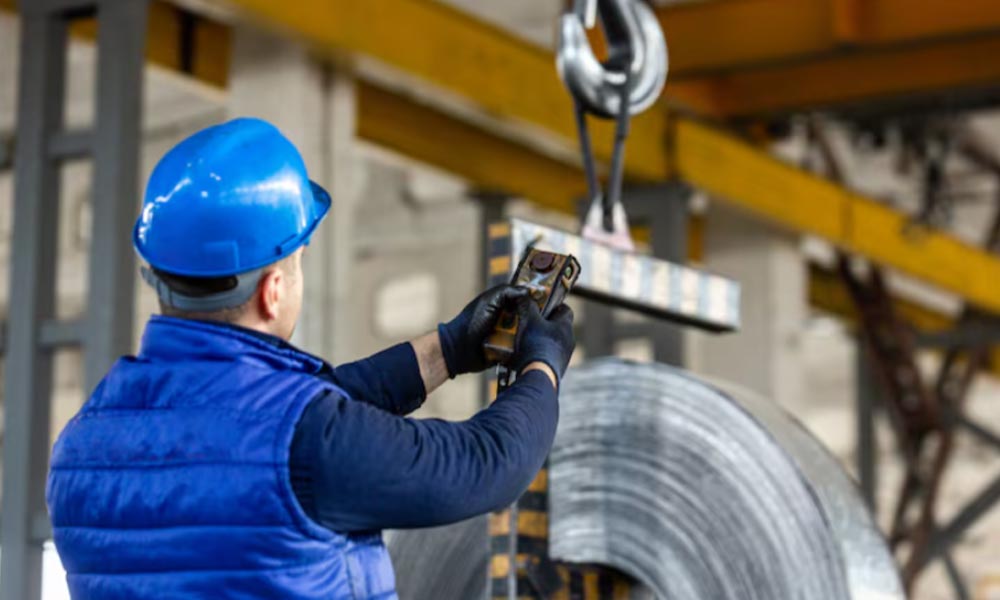
An operator lowers a die onto a work table, lets go of the hoist button, and watches the load settle another inch on its own before it stops. It happens fast, and on a busy floor it is easy to wave off as normal. The load is down, the next lift is waiting, and nobody wants to be the person who shuts a crane down over an inch.
That inch is not normal. It is the holding brake telling you it can no longer hold rated torque, and it is usually the first and cheapest warning you will get before a brake fails outright. This article covers how the two braking systems on an overhead crane actually work, the symptoms that mean a brake is slipping, what tends to cause it, how to test a brake without tearing it down, and the point where drift stops being a maintenance note and becomes a reason to lock the crane out.
Your crane has two brakes doing two different jobs
Before you can read the symptoms, you need to know which brake is talking. Every hoist carries a holding brake and, in almost every case, a separate control braking means, and they fail in different ways.
The holding brake is the one that stops and holds the load when the operator releases the hoist control. It is spring applied and electrically released, so it sets by spring force and only opens when the motor is powered. OSHA 29 CFR 1910.179 requires this brake to apply automatically when power is removed, so a power loss sets the brake instead of releasing the load. The same standard sets its minimum torque: at least 125 percent of full load hoisting torque when paired with a nonmechanical control braking means, or 100 percent when paired with a mechanical load brake, measured at the point where the brake is applied.
The control braking means governs speed on the way down. It can be an electrical method such as regenerative, dynamic, countertorque, or eddy current braking, or a mechanical load brake built into the gear train. Its job is to keep the load from overspeeding as it descends, not to hold it in place. A hoist can pass a holding test and still have a worn control brake, which is why both need checking.
Bridge and trolley travel brakes are the third piece, and they stop and hold horizontal motion. OSHA requires travel brakes sized to stop the bridge or trolley within a distance, in feet, equal to 10 percent of the full load travel speed in feet per minute. A bridge that coasts well past that mark is out of spec.
The warning signs a brake is losing its grip
The symptoms show up long before a brake gives out, if you know what you are watching and listening for. Watch for these in normal operation:
- Load drift after the control is released. Any downward creep once the operator lets go means the holding brake is no longer developing full torque. This is the single most important symptom, and it is often the only one you get before a real failure.
- Longer stopping distance or coasting. A load that takes longer to stop, or a bridge or trolley that overtravels its usual stopping point, points to a brake that is slipping or slow to set.
- Burning smell or heat at the brake. A brake that drags because it is not fully releasing runs hot, glazes its friction surface, and wears fast. Heat you can feel or smell is a brake working against itself.
- Chatter, grinding, or squeal on stops. Noise during braking usually means worn linings, a scored friction surface, or contamination.
- Visible glazing, scoring, or oil on the friction surface. A shiny glazed lining or a wet, oily brake face has lost the friction it needs, even when there is material left on it.
Any one of these is worth a work order. Drift under load is worth stopping the crane.
What is actually causing it
Most brake problems trace back to a short list of causes, and telling them apart decides whether you adjust or replace.
- Lining wear with no adjustment. Friction material wears with every stop. On a spring set brake, that wear widens the air gap, and past a point the brake can no longer set fully. Many brakes have an adjustment to pull the gap back in, and some have automatic adjusters, but both still have to be checked.
- Oil or grease contamination. A leaking gearbox or motor seal can put oil on the friction surface, which collapses the friction coefficient and lets the brake slip even with plenty of lining left. Cleaning rarely restores a contaminated lining, so this usually means replacement plus fixing the leak.
- Thermal overload. A high duty cycle, frequent plugging and reversing, or a brake that drags can push heat past the brake’s thermal capacity. Overheating hardens and glazes the lining and can warp discs or drums.
- Electrical faults. On electrically released brakes, a failing coil, rectifier, or wiring can keep the brake from releasing fully, which makes it drag, or from getting enough force, which makes it slip.
- Dust, moisture, and corrosion foul the mechanism and change how the brake sets and releases, especially on cranes that sit outdoors or in washdown areas.
The distinction matters at repair time. Simple wear you can adjust. Contamination, glazing, and thermal damage you replace.
How to test a brake without guessing
A brake test takes under a minute and does not require pulling anything apart. The operator test is built into the OSHA operating rules, which require the operator to test the brakes each time a load approaching rated capacity is handled by raising the load a few inches and applying the brakes. In practice, run it in three steps:
- Test the holding brake first. Lift a near capacity load a few inches, release the control, and watch it. The load should stop and hold with zero drift. Any movement is a fail.
- Then test the control brake. Raise the load a bit higher, then lower it and stop partway down. A hoist with a mechanical load brake will control the descent smoothly and hold when you stop. Overspeeding or a jerky descent points to a worn control brake.
- Check the travel brakes. Run the bridge and trolley at full speed with a load and confirm they stop within the expected distance and hold without drifting.
Beyond the operator test, a periodic inspection should measure lining thickness against the manufacturer’s wear limit, verify the air gap, confirm the brake develops rated torque, and inspect the friction surface, coil, and adjustment hardware. These checks belong in the crane’s scheduled inspection, which OSHA and the ASME B30 series both require on a defined cadence tied to how the crane is used.
When drift becomes a stop-work signal
A small amount of drift is tempting to treat as a maintenance item to get to later. It is a stop-work condition. A holding brake that cannot hold a static load has lost its safety margin, and the failure mode is a load that descends when it should not, with a worker or equipment underneath. Pull the crane from service, tag it out, and keep it down until the brake holds with no drift.
From there, the fix depends on the cause. Simple lining wear on an otherwise healthy brake is an adjustment or a lining replacement. A contaminated, glazed, or heat damaged brake needs new components, and in the case of contamination, the upstream leak repaired so it does not come back. Because a brake failure is one of the few crane faults with almost no warning and almost no backup, brake work is worth handing to a qualified overhead crane inspection and repair team rather than folding into a general maintenance patch, and worth building into a preventive maintenance program instead of waiting for a symptom. OSHA requires that preventive maintenance program to be based on the crane manufacturer’s recommendations, which is where you will find the specific wear limits, torque values, and adjustment intervals for your equipment.
The inch that saves you
Go back to that inch of drift on the work table. Treated as an annoyance, it is the last quiet moment before a brake lets a load go. Treated as information, it is the cheapest diagnostic you will ever run, a free signal that the brake needs attention while the load is still only a few inches off the table.
The habit that prevents brake failures is not complicated. Test the brakes on every near capacity lift, treat any drift as a reason to stop, keep linings clean and adjusted, and put brake inspection on a schedule that matches how hard the crane actually works. An overhead crane brake gives you plenty of warning. The facilities that stay out of trouble are the ones that listen to it.