

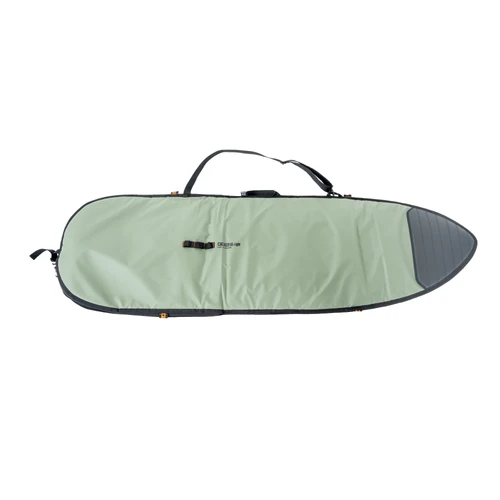
A surfboard bag should fit the board you actually ride, including its widest outline, thickest rails, and any protection needed during transport. Buying by length alone can leave the nose squeezed, the tail exposed to pressure, or the zipper struggling around extra padding. Meanwhile, unnecessary space allows the board to shift whenever you carry it. The right size therefore depends on measurements and purpose, rather than a matching number printed on a label. Whether your board travels across town or through an airport, a thoughtful fit helps protect its shape and makes every journey easier from departure to your destination.
Measuring and Choosing Your Surfboard Bag
Start with the surfboard resting on a stable surface, then measure its length from the nose to the tail. Record the maximum width across the deck and the thickness through the fullest section. These measurements provide a clearer starting point than the dimensions remembered from a purchase receipt. When comparing board bags for surfboards, check whether the listed size describes the board it accommodates or the bag itself. Those descriptions can mean different things, so read the sizing notes before ordering. A bag advertised for a particular board length may already include clearance, making an automatic size increase unnecessary. If internal dimensions are available, compare those measurements against your board rather than relying on the product name. Also consider repaired areas, protective rail tape, and anything else that changes the outline. Small differences become noticeable when a fitted cover closes tightly around the nose, rails, or tail during ordinary use.
Why Matching Lengths Can Still Mean Trouble
Two boards with identical lengths can require different bags because their outlines occupy space differently. A narrow nose slides into a tapered cover more easily than a broad, rounded nose, while a wide tail needs enough room near the zipper opening. This means a cover intended for a pointed shortboard may feel restrictive around a fuller board even when both carry the same length marking. Look closely at the bag silhouette and compare its widest sections with the board underneath. Pay attention to where the cover begins narrowing, since that transition can press against broad shoulders or a square tail. Thickness matters here too: fuller rails consume room that a flat width measurement does not reveal. If the manufacturer provides a fit chart, use it to check the intended outline. When information is limited, asking about your exact dimensions is more useful than guessing from a photograph or category label.
Leave Room for What Travels Inside
Decide what the bag must carry before settling on its size. A board transported with removable fins taken out has a different packing footprint from one stored with fins attached. Fixed fins require a bag designed to accommodate their height and position; simply adding length does not solve a shortage of depth. For removable fins, check whether the cover includes appropriate clearance or expects removal before packing. The same principle applies to extra protection. Nose guards, tail blocks, rail padding, and a thin protective sleeve all occupy space inside the bag. Allow enough room for your intended setup without turning the cover into a loose compartment. Accessories should also have secure storage rather than floating beside the board, where hard edges can create pressure points. Thinking through the complete packed arrangement helps you choose usable internal space instead of buying additional length that contributes little to the fit during transport.
Let the Journey Influence the Fit
A bag used for short drives faces different handling conditions from one packed for flights. For local sessions, a close fit can make carrying and storage straightforward, provided the zipper closes without pulling against the rails. For air travel, account for the protective materials you intend to add and the way the board sits inside the package. More padding requires more internal room, but excessive empty space can let the board move when the bag changes direction. Look for enough capacity to support a controlled packing arrangement, then use straps or suitable cushioning to limit shifting. If you travel with multiple boards, examine the stated capacity alongside your boards’ combined thickness and outlines. Two slim boards and two thick boards do not occupy the same volume. Treat board count as a starting description, then confirm whether the bag can accommodate the actual shapes and protection you plan to carry together.
Check the Fit Before Committing
Whenever possible, test the fit with the board positioned exactly as it would be during transport. Slide it inside gently and check whether the nose and tail settle naturally into their intended ends. Close the zipper without forcing the two sides together, then inspect the rails for compression. The board should feel supported while retaining enough clearance for easy removal. Lift the bag using its handle and shoulder strap, noticing whether the board shifts abruptly or whether either end droops excessively. A little movement does not automatically indicate a poor fit, but large gaps deserve closer attention. Repeat the check with your planned padding and fin arrangement, because an empty trial can disguise a cramped travel setup. For online purchases, compare measurements carefully and review the return conditions before ordering. A practical fitting process can reveal problems that size labels and product photographs leave difficult to judge from appearance alone.
Conclusion
Choosing a surfboard bag becomes easier when you treat size as a relationship between length, outline, depth, and packing needs. Begin with measurements, check how the manufacturer defines its sizing, and match the cover shape to the board. Then consider fins, cushioning, accessories, and the number of boards you expect to carry. A useful fit closes comfortably, protects the extremities without squeezing them, and avoids unnecessary room that encourages movement. There is no reason to increase the size automatically if the stated fit already includes clearance. Equally, matching the printed board length means little when the nose or rails are crowded. Before committing, imagine the complete packed setup and how you will lift, store, and transport it. The right purchase is the bag that accommodates that real arrangement comfortably, giving your board dependable coverage and making the trip from storage to the shoreline feel manageable every time you head out.